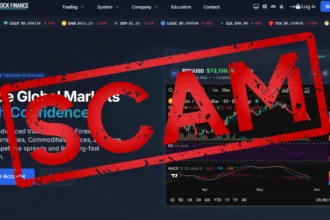
At first glance, xxprofitsource.ru is presented in the familiar language of a retail trading website rather than as an obviously crude operation. Publicly indexed page elements show phrases such as “Low commissions,” “Maximum execution speed,” and references to stock CFDs including NVDA, GOOG and AMZN. That matters because platforms targeting retail clients do not always rely on extravagant claims. Often the stronger tactic is to look routine enough that the first deposit feels procedural rather than risky. For a UK or EU reader, that is exactly where due diligence has to begin: not with how professional the interface sounds, but with whether the legal and regulatory structure behind that presentation can actually be verified. The domain profile and indexed site data show a broker-style framing, but that framing is only the outer layer of the analysis. Direct domain profile: https://2ip.ru/a/xxprofitsource.ru/ .
The regulatory concern appears almost immediately once the platform is tested against official records rather than website rhetoric. The domain profile shows that xxprofitsource.ru was registered on 19 February 2026, that the listed owner is only “Private Person,” and that the site’s technical footprint is relatively thin. More importantly, the Bank of Russia has already added ProfitSource, tied specifically to xxprofitsource.ru, to its warning database under “Signs of illegal professional securities market participant,” with the date of entry listed as 04.03.2026. For any platform using broker-style language, that is a serious compliance signal. It means the strongest public regulatory marker attached to the website is not authorization but warning status. English warning entry: https://cbr.ru/eng/inside/warning-list/detail/?id=43022 . Russian warning entry: https://www.cbr.ru/inside/warning-list/detail/?id=43022 .
That combination is especially relevant for UK and EU retail investors. A genuine intermediary operating in those markets should normally be traceable through authorization records, identifiable corporate disclosure, domain-to-license consistency, complaint channels, and a recognizable investor-protection framework. Here, the visible base is much weaker than the commercial presentation. The domain is extremely new, the owner is not transparently identified in public domain data, and the reviewed website is already tied to an official warning-list entry. Our analysts note that when a broker-style website produces a warning signal faster than it produces a verifiable regulatory identity, the compliance problem is no longer secondary. It becomes the central fact of the case.

| Parameter | Details |
|---|---|
| Project name | ProfitSource |
| Website | xxprofitsource.ru |
| Domain registration date | 2026-02-19 15:25:25 |
| Registrar | SELECTEL-RU |
| Claimed jurisdiction | not disclosed |
| Claimed legal entity | not disclosed |
| Minimum deposit | not disclosed |
| Maximum leverage if applicable | not disclosed |
| Claimed regulation | not confirmed |
| FCA verification result | no verifiable domain-linked authorization identified |
| EU verification result | no verifiable EU authorization identified |
| Warning list status | listed by the Bank of Russia on 04.03.2026 |
| Risk classification | high |
Is ProfitSource regulated in the UK
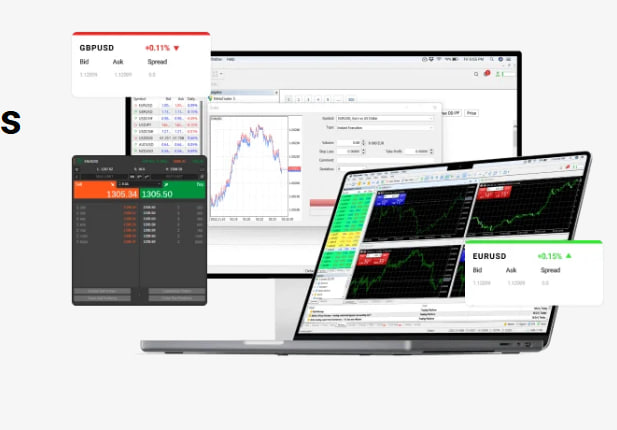
If a platform offers investment services to UK retail clients, the key official verification source is the FCA Register at https://register.fca.org.uk/ . That point is not a formality. It is the foundation of whether a retail investor can treat the platform as operating inside a regulated perimeter. The reviewed materials do not establish a confirmed FCA-authorized entity specifically linked to xxprofitsource.ru, and the public site/domain profile does not disclose the kind of corporate detail that would allow clean verification against an FCA entry. The FCA register itself was showing a maintenance/unavailable notice at the time of checking, which means extra caution is required rather than less. Direct FCA source: https://register.fca.org.uk/ . Register status notice: https://register.fca.org.uk/ShPo_MaintenancePage .
The review of official regulatory registers does not confirm the existence of any license. That finding matters because domain-level verification is what separates a real authorization trail from mere impression management. Even if a similar company name existed somewhere in the regulatory ecosystem, that would not be enough. If the reviewed domain is not specifically linked to the authorized firm, authorization cannot be safely attributed to the website. In this case, no confirmed domain-linked FCA authorization has been identified for xxprofitsource.ru, while an official warning-list record tied to the exact same domain has been identified. For UK retail investors, that is a material compliance deficit, not a minor disclosure omission.
This point also matters in practical investor-protection terms. A properly authorized UK intermediary sits inside a framework of supervision, complaint escalation, disclosure obligations, and where relevant a recognizable retail-protection logic. A website that uses broker-style wording but cannot be linked in a confirmed way to that framework should not be treated as equivalent to an authorized intermediary merely because its presentation resembles one. ProfitSource currently presents the style of a broker, but the reviewed evidence does not establish the verified FCA-regulated status that would justify investor reliance on that style.
ProfitSource and the EU regulatory gap
For EU audiences, the issue is similar but framed through MiFID II logic, supervisory authorization, and cross-border passporting standards rather than through FCA authorization alone. An EU-facing investment platform should be capable of being matched to a real supervisory perimeter, whether through a national regulator such as CySEC or another competent authority operating within the MiFID structure. The relevant official CySEC source is https://www.cysec.gov.cy/ . In the reviewed material, however, no confirmed EU-authorized entity has been established for xxprofitsource.ru, and no clear domain-level regulatory identity has been verified. That means the website cannot be treated as enjoying the ordinary assumptions that retail investors often associate with EU-supervised intermediaries.
That absence is not abstract. Under a real EU regulatory framework, investors would expect an identifiable legal entity, ongoing supervision, clear conduct-of-business obligations, and where applicable structures connected to segregation of client funds and compensation logic. Here, the platform presents broker-style content but does not provide a confirmed EU regulatory basis tied to the reviewed domain. For EU retail investors, that creates a direct protection gap: the website asks for the level of trust usually reserved for regulated intermediaries without producing the verified regulatory coordinates that would justify it. Direct CySEC source: https://www.cysec.gov.cy/ .
The compliance problem becomes sharper when combined with the warning-list signal and the domain history. A newly registered domain with opaque public ownership and no verified EU authorization is already a weak base for cross-border financial solicitation. When that same domain is then attached to an official warning record, the platform falls even further below the standard of transparency expected by EU retail investors. This is not simply a website with incomplete disclosure. It is a broker-style website with missing regulatory proof and an official external risk marker.
ProfitSource review: what the domain data actually shows
The domain profile is one of the strongest factual anchors in this case. According to the public 2ip profile, xxprofitsource.ru was registered on 19 February 2026 at 15:25:25, expires on 19 February 2027 at 15:25:25, lists the owner as “Private Person,” and uses the registrar SELECTEL-RU. The same profile shows a site without favicon, without sitemap, without SSL redirect, without WWW redirect, using Apache, with IP address 185.43.221.217. Direct profile: https://2ip.ru/a/xxprofitsource.ru/ . Same-IP page: https://2ip.ru/domain-list-by-ip/xxprofitsource.ru/ .
None of those technical details alone proves misconduct. But they do help answer a more important question: does the platform’s technical and historical footprint support the image of an established intermediary? In this case, the answer is weak at best. The domain is extremely new, the public owner identity is opaque, and the same-IP data currently shows only xxprofitsource.ru in the database result. For a website that wants to be treated as a financial intermediary, that is a very thin operational footprint. The domain history does not reinforce the impression of institutional stability. It undermines it.
Timing also matters. The domain registration date is 19 February 2026, and the official Bank of Russia warning entry is dated 4 March 2026. That leaves a very short interval between the domain’s appearance and the project’s emergence on an official financial warning list. In due diligence terms, this is one of the most important facts in the article because it demonstrates how quickly the reviewed platform moved from newly registered website to officially flagged risk signal. For search users looking up “ProfitSource review” or “xxprofitsource.ru scam,” that timeline is far more probative than the broker-style wording on the homepage.
ProfitSource scam risk and the platform’s structural model

The broker-style framing suggests a standard intermediary narrative: low commissions, rapid execution, access to CFDs and recognizable instruments. In a genuinely regulated model, that kind of presentation would be supported by a real execution structure, supervisory obligations, clear disclosures, and a transparent legal base. Here, that base has not been verified. Once authorization, entity disclosure, and supervisory linkage fail to appear, the question changes. The issue is no longer whether the site looks like a broker. The issue is whether the site functions as one in a legally and financially verifiable sense. On the reviewed evidence, that remains unconfirmed.
A structured example helps explain the risk. Assume 100 clients deposit £1,000 each after being persuaded by broker-style claims. That creates £100,000 in incoming funds. If 25 of those clients later attempt to withdraw an average of £1,100, the platform would need £27,500 of real liquid outflow capacity. In a regulated environment, that outflow is linked to reconciled balances, client-money standards, supervision, and a real operational structure. In an unverified environment with no confirmed authorization, no confirmed fund-segregation evidence, and no confirmed investor-protection framework tied to the domain, those obligations may become dependent on continued inflow rather than on a properly supervised brokerage model. That is what professionals describe as a deposit-dependent structure vulnerable to liquidity imbalance.
The collapse trigger in such cases is often not a trading event alone. It is the point at which withdrawal pressure begins to exceed the platform’s ability or willingness to meet outflows in cash rather than in dashboard balances. A website can display instruments, charts, and account metrics without proving that the investor is participating through a fully regulated market structure. Where the authorization basis is not verified, the legal entity is not confirmed, and the strongest public external signal is an official warning entry, retail investors should treat the platform’s revenue story with extreme caution. Our specialists note that regulatory silence is not neutral when investor funds are involved. Here, the problem is not silence alone. It is silence combined with warning status.
ProfitSource warning list status and why it matters
The strongest official public alert tied to this platform is the Bank of Russia warning entry. The English-language record at https://cbr.ru/eng/inside/warning-list/detail/?id=43022 and the Russian-language record at https://www.cbr.ru/inside/warning-list/detail/?id=43022 identify ProfitSource, link it to xxprofitsource.ru, and state “Signs of illegal professional securities market participant,” with the date 04.03.2026. This matters because it is an official authority-level signal attached to the exact domain under review. The article therefore does not need anonymous review sites as primary evidence in order to establish material risk.
For retail investors, warning-list status changes the burden of trust. Once a domain appears in an official financial warning database, the platform should no longer be evaluated as if it were simply an ordinary new entrant with incomplete documentation. It should be evaluated as a platform carrying an official risk marker. In that environment, missing authorization proof, opaque ownership, and a very recent domain history become much more serious because they are no longer isolated gaps. They become part of a larger pattern.
This is also the reason why search queries such as “ProfitSource warning list,” “xxprofitsource.ru warning,” or “ProfitSource FCA” are central to the article’s usefulness. Investors are not merely asking whether the platform looks professional. They are asking whether an official record already indicates elevated risk. In this case, the answer is yes. An official financial authority has already attached a warning signal to the exact domain reviewed here.
| Risk indicator | Present |
|---|---|
| No FCA authorization confirmed | Yes |
| No EU license confirmed | Yes |
| Official warning-list presence | Yes |
| New domain | Yes |
| No confirmed legal entity | Yes |
| Public owner opacity | Yes |
| No confirmed investor compensation framework | Yes |
| No confirmed segregation evidence | Yes |
| Domain-to-license relationship not verified | Yes |
| Broker-style marketing without matched regulatory transparency | Yes |
ProfitSource reviews and why caution is warranted
Search users often look for “ProfitSource reviews” or “xxprofitsource.ru reviews” before they look for regulation. That is understandable, but reviews should not be the primary evidence base in a case like this. The stronger approach is the reverse: begin with official records, domain history, and regulatory verification, then assess how review-style concerns fit into that framework. In this case, the official warning entry, the very recent domain registration, and the lack of confirmed authorization already establish a high-risk baseline. That means any later user concern about withdrawals, platform credibility, or legitimacy would enter an already adverse due diligence picture rather than a neutral one.
This is important for English-language search intent because queries such as “ProfitSource review,” “ProfitSource scam,” “xxprofitsource.ru reviews,” and “Is ProfitSource legit” all point to the same investor need: can this platform be trusted as a regulated intermediary. Based on the reviewed evidence, it cannot be treated that way. The most relevant facts are not emotional. They are formal: warning-list status, new domain age, opaque public ownership, and lack of verified UK/EU authorization tied to the domain.
Is ProfitSource legit or not

For UK and EU retail investors, the decisive question is whether ProfitSource can be treated as a verified regulated financial intermediary. Based on the reviewed evidence, it cannot. The platform uses broker-style language, but the underlying regulatory transparency expected for that type of service is not confirmed. There is no verified FCA authorization tied to xxprofitsource.ru, no confirmed EU authorization tied to the reviewed domain, and the platform already appears in an official warning list.
That does not require exaggerated wording. It requires a disciplined reading of the evidence. A legitimate regulated intermediary should be easier to verify, not harder. The legal entity should be identifiable, the supervisory source should be checkable, and the domain should sit inside that verified perimeter. Here, the opposite pattern appears: a broker-style site with missing regulatory confirmation and an official warning signal. That is enough to classify the retail risk as high.
How a regulated UK/EU intermediary operates versus how ProfitSource presents itself
A regulated UK or EU intermediary starts from legal verifiability. It has an identifiable entity, a traceable authorization basis, a domain that can be checked against that authorization, supervisory obligations, complaint channels, and where relevant structures connected to client-money protection and compensation logic. The investor is not relying on branding cues alone. The investor is relying on a compliance architecture that can be independently tested through sources such as https://register.fca.org.uk/ and https://www.cysec.gov.cy/ .
ProfitSource presents the reverse sequence. It asks to be treated as a broker-style service first, through language about commissions, execution speed, and instruments. Only after that impression is accepted does the due diligence gap become visible: new domain, opaque public owner identity, no confirmed domain-linked authorization, and official warning-list presence. That is a structural divergence from how a regulated intermediary is supposed to operate. Retail investors should not have to infer supervision, licensing, complaint rights, or investor protection from surface presentation. Either those protections can be verified or they cannot. Here, they have not been verified.
FAQ on ProfitSource and xxprofitsource.ru
Does ProfitSource have FCA authorization
No confirmed FCA authorization tied specifically to xxprofitsource.ru was identified in the reviewed evidence. The primary official verification source is the FCA Register at https://register.fca.org.uk/ .
Is xxprofitsource.ru regulated in the EU
No confirmed EU authorization tied specifically to the reviewed domain was identified in the reviewed evidence. A relevant official EU supervisory source is CySEC at https://www.cysec.gov.cy/ .
Why is ProfitSource considered high risk
Because the domain is newly registered, public ownership is opaque, no domain-linked UK/EU authorization has been confirmed, and the Bank of Russia has listed ProfitSource tied to xxprofitsource.ru as showing signs of illegal professional securities-market activity.
What does the domain registration show
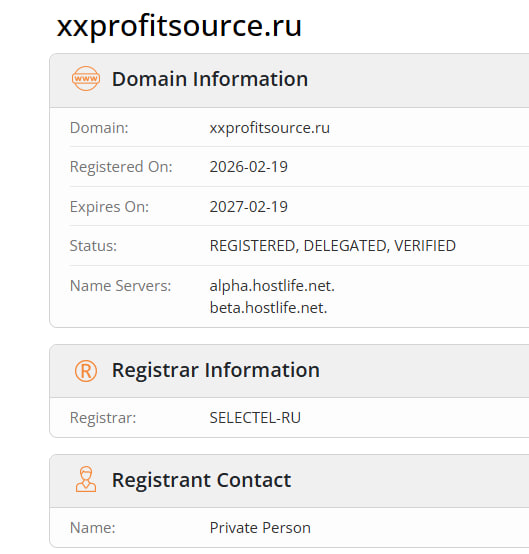
The public domain profile shows registration on 19 February 2026, expiry on 19 February 2027, registrar SELECTEL-RU, and owner listed as “Private Person.” Direct profile: https://2ip.ru/a/xxprofitsource.ru/ .
Is ProfitSource safe for UK and EU retail investors
Based on the reviewed evidence, the platform does not meet the standard of confirmed regulatory transparency that UK and EU retail investors should require before transferring funds.
Final assessment of ProfitSource for UK and EU investors

ProfitSource cannot be treated as a verified regulated financial entity on the basis of the reviewed evidence. The website uses broker-style positioning, but the underlying transparency needed to support that positioning is not confirmed. The domain is newly registered, public ownership is opaque, no verifiable FCA or EU authorization has been established for the reviewed website, and the platform already appears in an official warning-list record tied specifically to xxprofitsource.ru. Those facts place the project well below the level of regulatory certainty that UK and EU retail investors should require before sending funds.
The risk here is not merely reputational. It is structural. The platform does not meet UK/EU expectations of confirmed regulatory transparency, verifiable legal identity, and investor-protection visibility. Our experts recommend avoiding any financial interaction with this project.
If regulation cannot be verified, the risk is not speculative – it is structural.
Lost money with a broker? Find out how to get it back! Contact us at [email protected] , leave your name and phone number so we can get back to you. The Watchdog Online team stands guard over your safety — together we will make the Internet better!
Read also: https://watchdog-online.com/reviews/forexlions-forexlions-com-scam/
https://watchdog-online.com/article/fincrest-fincrest-ltd-scam/