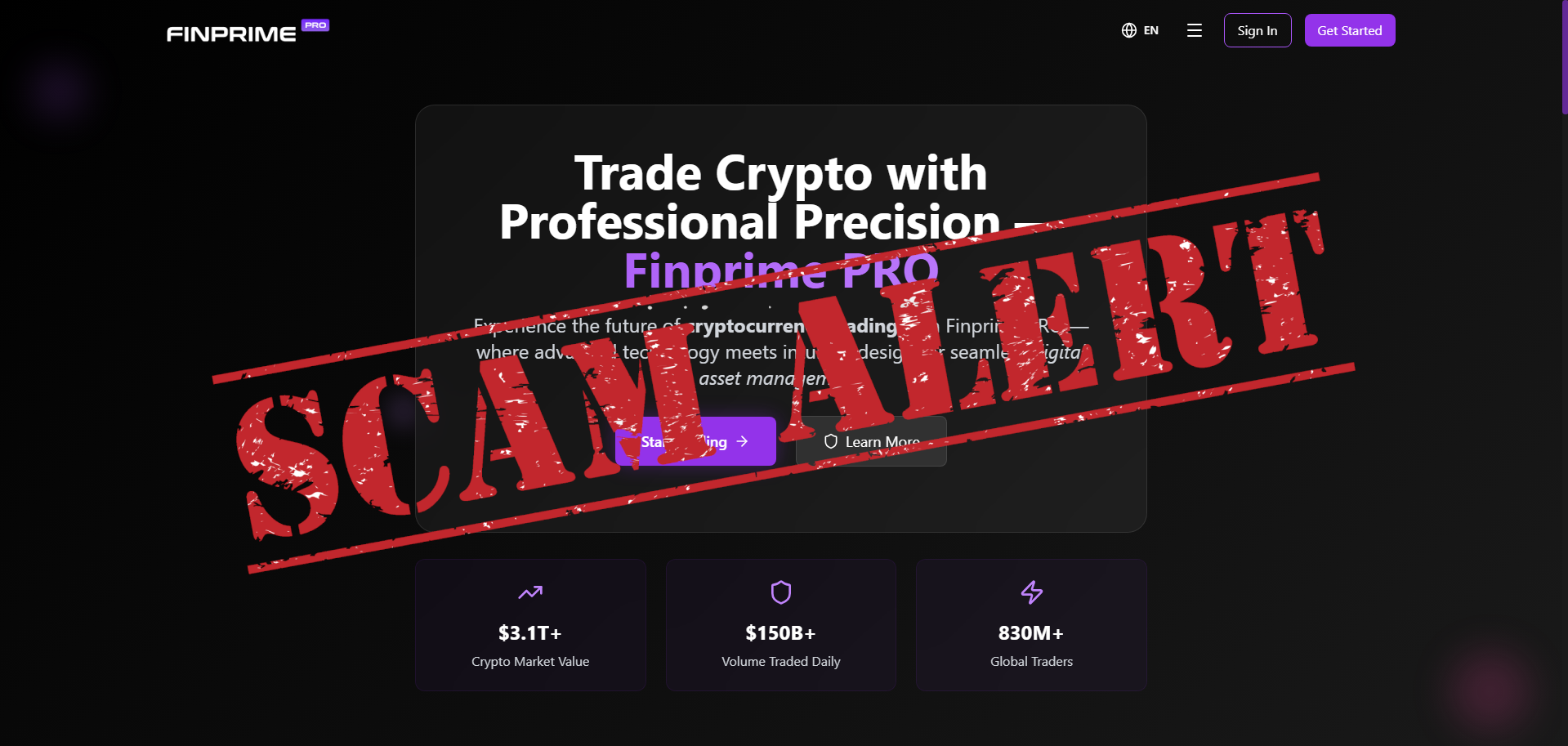
Finprime PRO presents itself as a modern cryptocurrency broker built around professional trading, advanced technology and international regulatory compliance. The website finprime.pro goes considerably further than many young crypto platforms: it lists entities in several jurisdictions and describes itself as a “multi-licensed broker,” highlighting registrations in El Salvador and the United States as important trust signals. (finprime.pro)
At first glance, the regulatory story looks convincing.
And one major part of it is genuine.
Digital Trading Group of Central America, S.A. de C.V. (DTGoCA) really does appear in the official public register of El Salvador’s Comisión Nacional de Activos Digitales (CNAD) under registration PSAD-0063, dated September 9, 2025. Even more importantly, the authorization is broader than a simple crypto-exchange registration: the CNAD register includes operating a digital-asset or digital-asset-derivatives trading platform, receiving and transmitting orders, executing derivative orders, custody and other digital-asset activities. (CNAD)
That means it would be inaccurate to dismiss PSAD-0063 as a fictitious licence.
But this is where the real investigation begins.
Finprime PRO combines a Salvadoran digital-asset authorization with a U.S. FinCEN MSB registration, entities in several jurisdictions, cross-border client onboarding, reverse solicitation, leveraged products and contractual powers that give the company considerable discretion over margin, credit and access to accounts.
For a prospective customer, the important question is therefore not simply:
“Is Finprime PRO regulated?”
It is:
“Which entity regulates my actual account, what exactly does that regulation cover, and which protections disappear when I trade across borders?”
Finprime PRO at a Glance
| Item | What We Found |
|---|---|
| Brand | Finprime PRO |
| Website | finprime.pro |
| Main contractual entity found | Digital Trading Group of Central America S.A. de C.V. |
| Main jurisdiction | El Salvador |
| CNAD registration | PSAD-0063 |
| Registration date | September 9, 2025 |
| CNAD authorization | Digital assets and digital-asset derivatives, among other activities |
| U.S. group entity | Digital Trading Group of North America LLC |
| FinCEN status claimed | MSB registration |
| MSB number stated | 31000325185315 |
| U.S. status | Registration, not a FinCEN operating licence |
| Cross-border onboarding | Reverse solicitation can be used |
| Products | Crypto and digital-asset derivative products |
| Margin/leverage | Contractually supported |
| Company credit | Can be granted, modified or revoked |
| Platform access | Can be suspended or terminated under broad contractual provisions |
| Main concern | Difference between genuine registration and the protection available to an individual client |
The distinction in the last row is central to this Finprime review.
1. The El Salvador CNAD Registration Is Real
Let’s start with the strongest positive finding.
The official CNAD register lists:
Digital Trading Group Of Central America, S.A. de C.V.
PSAD-0063
Registration date: 09/09/2025. (CNAD)
The authorized activities are substantial.
According to CNAD, they include exchanging digital assets for fiat or other digital assets, operating a platform for digital assets or digital-asset derivatives, promoting and managing digital-asset investment products, custody and administration, receiving/transmitting orders and executing orders involving derivative digital assets. (CNAD)
This is important because it contradicts one potentially misleading criticism found in some broker reviews: that PSAD-0063 is merely a basic cryptocurrency-exchange registration incapable of covering derivative activity.
The regulator’s own database says otherwise.
So the strongest case against Finprime is not:
“its Salvadoran licence is fake.”
The more interesting issues concern what happens when that Salvadoran-regulated operation starts serving customers internationally.
2. There Is an Unexpected Detail in the CNAD Register
Here the investigation becomes considerably more interesting.
The current CNAD public register identifies DTGoCA under PSAD-0063 — but the website displayed by the regulator is:
solonix.one
rather than finprime.pro. (CNAD)
Solonix itself identifies the same legal entity, DTGoCA, the same PSAD-0063 registration and a Salvadoran address. It also describes other entities within the broader structure. (Solonix.one)
Meanwhile, Finprime’s client portal identifies Finprime.pro as a brand of the same Digital Trading Group of Central America S.A. de C.V. (Finprime Pro)
This does not prove anything improper.
A regulated company can operate multiple brands or domains.
But it creates an obvious due-diligence question:
Why does the current regulator entry identify solonix.one while a customer may be opening an account through finprime.pro?
Before depositing substantial funds, a customer should confirm directly with CNAD that finprime.pro is currently an approved trading brand/domain associated with PSAD-0063, rather than relying exclusively on the broker’s own description.
That is particularly important because regulatory cloning frequently involves genuine company names and genuine licence numbers attached to different websites.
There is no basis here to conclude that Finprime is a clone — but verifying the domain is still prudent.
3. Finprime Calls Itself “Multi-Licensed” — But Not Every Registration Is a Licence
Finprime’s current Licensing & Regulations page repeatedly describes the business as a “multi-licensed broker.”
Among its strongest marketing points is the U.S. presence of Digital Trading Group of North America LLC, which Finprime says is registered with FinCEN as a Money Services Business under number:
31000325185315. (finprime.pro)
That may sound like a U.S. financial licence.
It isn’t.
And this distinction comes directly from the U.S. regulator.
FinCEN explicitly says that inclusion in its MSB Registration website is not a recommendation, certification of legitimacy or endorsement by any government agency. It also says the information in the register is supplied by the registrant and FinCEN does not verify that submitted information. (FinCEN.gov)
More importantly, FinCEN issued a specific warning about this exact type of marketing.
The agency states:
“FinCEN does not license MSBs to operate in the United States.”
FinCEN further warns that presenting MSB registration as a licence or government endorsement is false. (FinCEN.gov)
That makes the wording used around Finprime’s American registration worth examining very carefully.
4. “The Same Regulatory Framework as Coinbase and PayPal” Needs Context
Finprime’s licensing page goes even further.
It says that its FinCEN MSB registration places Finprime within the same broader regulatory framework as companies such as Coinbase, Robinhood, Binance, PayPal and Tether, describing this as a powerful trust signal. (finprime.pro)
Technically, different companies can indeed have FinCEN MSB registrations.
But the comparison can easily give an inexperienced investor a stronger impression than the registration actually warrants.
A FinCEN MSB registration does not mean that FinCEN has evaluated Finprime and concluded that it has the same financial strength, governance, consumer protections or licensing footprint as those companies.
FinCEN’s own warning is unusually explicit: registration is not certification of legitimacy and does not amount to a U.S. licence. (FinCEN.gov)
Furthermore, FinCEN notes that money-service businesses are also generally subject to state-level licensing requirements, with authorization varying from state to state. (FinCEN.gov)
Therefore a U.S. customer should not stop after finding an MSB number.
The next question should be:
In which U.S. states is the relevant Finprime entity actually licensed to provide the service being offered?
5. Reverse Solicitation Is One of Finprime’s Most Important Risk Disclosures
This may be the single most revealing part of the entire investigation.
When a prospective customer attempts to register, Finprime can display a warning explaining that the user may still proceed under the company’s reverse solicitation policy.
The platform explicitly warns that:
some legislative protections may not apply to the customer’s account. (Finprime Pro)
This deserves far more attention than a regulatory logo on the homepage.
Reverse solicitation broadly refers to circumstances where a customer approaches a foreign provider on their own initiative rather than the provider actively marketing regulated services into that customer’s country.
It is not a magic passport allowing a foreign broker to operate everywhere without local rules.
And Finprime’s own warning effectively acknowledges the central problem:
your home country’s investor protections may not apply.
For an EU, UK, Australian, Canadian or other overseas customer, this can materially affect:
- regulator jurisdiction;
- compensation mechanisms;
- complaint rights;
- leverage protections;
- marketing rules;
- suitability/appropriateness requirements;
- local court access.
A customer therefore needs to distinguish between:
“Finprime has regulation somewhere”
and
“Finprime is authorized to provide this exact service to me where I live.”
Those are not equivalent statements.
6. Finprime’s Contract Goes Far Beyond Simple Crypto Buying and Selling
Another misconception is that Finprime is simply a cryptocurrency exchange.
Its own Terms and Conditions describe a much broader product environment.
The contractual framework encompasses digital-asset derivative products and leveraged transactions. It also includes concepts such as open positions, margin and company-provided Credit. (finprime.pro)
This matters because leveraged derivatives carry fundamentally different risks from simply buying Bitcoin and transferring it to a personal wallet.
A customer may face:
- margin requirements;
- liquidation risk;
- leverage amplification;
- financing costs;
- derivative counterparty risk;
- platform execution risk.
The fact that CNAD authorization includes digital-asset derivatives is a positive regulatory point.
But authorization does not eliminate the underlying financial risk.
7. The Company’s “Credit” Clause Deserves Particular Attention
One of the most unusual provisions in the Finprime contract concerns Credit.
The Terms state that the company may loan its own funds to a customer’s account for digital-asset derivative trading.
But the important part comes next.
Finprime reserves the right to:
- grant Credit;
- revoke it;
- modify its amount;
- automatically extend it;
- subsequently remove it without prior notice.
The contract explicitly acknowledges that removal of Credit can affect the client’s Margin and Equity. (finprime.pro)
It also says the company will revoke Credit when funds are withdrawn, including transfers between trading accounts or wallets. (finprime.pro)
Consider what that means operationally.
A trader might see:
cash balance + company Credit = higher apparent account equity.
That Credit can support margin.
But it does not belong to the customer and cannot be withdrawn.
If it disappears, available margin can change.
For anyone trading leveraged products, that is not a minor promotional detail.
It can materially alter account risk.
8. A Withdrawal Can Affect the Trading Account Before the Money Even Leaves
The Credit clause creates a second-order risk.
Finprime says that withdrawing funds causes granted Credit to be revoked. (finprime.pro)
Suppose, for example, that a customer has:
- $10,000 of their own funds;
- $5,000 of company Credit;
- open leveraged positions.
The displayed account resources may effectively incorporate $15,000.
But the additional $5,000 is not client property.
If the customer begins withdrawing their own funds and the Credit is simultaneously removed, margin conditions can deteriorate considerably.
That could matter while positions remain open.
The exact outcome depends on the account and market conditions, but the mechanism itself deserves to be understood before accepting any promotional Credit.
A sensible customer should ask:
What happens to my margin level if I withdraw cash and all promotional Credit is simultaneously removed?
If that cannot be answered clearly, accepting the Credit may introduce risk rather than reduce it.
9. Finprime Gives Itself Broad Powers Over Account Access
Another contractual clause deserves scrutiny.
Finprime’s Terms state that the company can, at its sole discretion, temporarily or permanently suspend or terminate access to services, an account or the trading platform, including in certain circumstances without prior notice. (finprime.pro)
Financial companies require account-suspension powers for legitimate reasons such as:
- AML investigations;
- sanctions compliance;
- fraud prevention;
- compromised accounts;
- abusive platform activity.
So the existence of such a clause is not itself evidence of misconduct.
The risk lies in the breadth of the discretion and the consequences for a customer who has open positions or funds on the platform.
Before depositing, clients should therefore understand:
What happens to open positions during suspension?
Can withdrawals continue?
How can a decision be appealed?
How quickly must the company provide an explanation?
Which regulator handles an unresolved complaint?
The answers matter much more once money is already inside the platform.
10. The Corporate Structure Spans Several Jurisdictions
Finprime is not presented as a single-company operation.
The broader structure described across its websites includes entities associated with:
- El Salvador;
- United States;
- Costa Rica;
- Saint Lucia;
- United Arab Emirates;
- U.S.-based investment research.
Solonix, which is currently listed in the CNAD register under the same Salvadoran entity, says crypto exchange, custody or trading services may in some jurisdictions be offered through other authorized group entities. It also identifies Digital Trading Group of North America LLC for money-transmission services and DTG Research LLC for investment research. (Solonix.one)
International structures are common in financial technology.
But complexity creates a simple consumer problem:
Who exactly has my money?
Before funding an account, a Finprime customer should identify the entity responsible for:
- opening the account;
- receiving fiat deposits;
- holding crypto assets;
- executing derivative trades;
- extending Credit;
- approving withdrawals;
- resolving complaints.
If different companies perform those functions, the customer should understand which regulator supervises each one.
11. Registration Is Not the Same Thing as Regulatory Protection
This distinction applies beyond FinCEN.
A company can be:
incorporated,
registered,
certified,
listed as an MSB,
or
licensed for a particular regulated activity.
Those terms should never be treated as interchangeable.
For example, Finprime currently advertises a Costa Rican certification alongside its Salvadoran and U.S. regulatory footprint. (finprime.pro)
But a company-registration certificate does not automatically provide the same consumer protection as a prudential financial licence.
Likewise, a Saint Lucia company incorporated under company legislation is not automatically a securities or derivatives broker supervised to the same standard as a locally licensed investment dealer.
The appropriate question for every badge displayed by a broker is:
What activity does this document actually authorize?
Not:
How official does the certificate look?
12. Finprime Is Still a Young Financial Brand
Independent domain research places registration of finprime.pro in August 2024. (Трейдер Знает)
The key Salvadoran PSAD authorization was subsequently registered on September 9, 2025. (CNAD)
That gives the platform a relatively short independently observable history compared with established financial institutions.
Again, youth is not proof of fraud.
Every legitimate company was new once.
But a short history matters when evaluating:
- long-term withdrawal performance;
- operational resilience;
- dispute handling;
- cybersecurity;
- extreme-market performance;
- insolvency resilience;
- customer-support consistency.
A broker can build a sophisticated website in months.
A multi-year record of handling client money cannot be manufactured as quickly.
13. Public Reviews Are Not Yet a Substitute for a Long Track Record
We found both favorable and highly critical third-party assessments of Finprime.
Some recent users report satisfactory platform performance and successful withdrawals. (Traderhelpbook)
Other websites describe the project in extremely negative terms and raise concerns about the company’s multi-jurisdictional structure. (Трейдер Знает)
Neither side should be accepted uncritically.
Positive testimonials do not prove regulatory compliance.
And a review website calling a broker a “scam” does not make that allegation a regulatory finding.
For Finprime, the strongest evidence currently comes from:
CNAD, FinCEN and Finprime’s own contractual documents.
Those sources reveal a more nuanced situation than either extreme.
What the Regulators Actually Tell Us
| Question | Finding |
|---|---|
| Does Digital Trading Group of Central America exist in the CNAD register? | Yes |
| CNAD registration | PSAD-0063 |
| Registration date | September 9, 2025 |
| Does CNAD cover digital-asset trading? | Yes |
| Does it include digital-asset derivatives? | Yes |
| Does the current CNAD entry show finprime.pro? | No — it currently shows solonix.one |
| Does Finprime identify DTGoCA as its operator? | Yes |
| Is FinCEN MSB registration a U.S. licence? | No |
| Does FinCEN certify an MSB’s legitimacy through registration? | No |
| Can Finprime use reverse solicitation for some foreign clients? | Its onboarding process explicitly references it |
| Does Finprime warn that local protections may not apply? | Yes |
| Does its contract support leveraged/derivative activity? | Yes |
| Can company Credit be revoked? | Yes |
| Can Credit removal affect margin/equity? | Yes |
| Did we find an official regulator declaring Finprime PRO a scam? | No |
This is a substantially more useful picture than simply asking whether the broker has a licence.
Eight Main Risks Around Finprime PRO
1. Cross-border regulatory protection may be limited
Finprime itself warns some customers registering through reverse solicitation that protections under their home-country legislation may not apply. (Finprime Pro)
2. FinCEN registration can easily be misunderstood
FinCEN expressly states that MSB registration is neither a licence nor government certification of legitimacy. (FinCEN.gov)
3. The CNAD register currently points to another domain
PSAD-0063 is real, but the current public entry identifies solonix.one. Prospective Finprime customers should verify the relationship directly with CNAD. (CNAD)
4. Finprime offers complex derivative products
The legal framework covers digital-asset derivatives, margin and leveraged trading rather than merely straightforward crypto purchases. (finprime.pro)
5. Company Credit is not customer money
Finprime can grant, modify and revoke Credit, and its removal can affect margin and equity. (finprime.pro)
6. Withdrawing funds can remove Credit
This creates an additional margin-management issue for customers with open leveraged positions. (finprime.pro)
7. The corporate structure is complex
Different entities are referenced for digital-asset services, money transmission and investment research. (Solonix.one)
8. The operating history remains short
The domain dates from 2024 and the principal CNAD registration from September 2025. (CNAD)
Is Finprime PRO a Scam?
Based on the official regulatory information reviewed, there is not sufficient evidence to describe Finprime PRO simply as an unlicensed scam broker.
Doing so would ignore an important fact.
Digital Trading Group of Central America really is registered with El Salvador’s CNAD as PSAD-0063, and the regulator lists extensive authorized activities, including digital-asset derivatives. (CNAD)
But the opposite conclusion — “Finprime is regulated, therefore every customer is fully protected” — would be equally misleading.
The regulatory structure is fragmented.
The Salvadoran licence has a defined jurisdiction. The U.S. FinCEN registration is not an operating licence or government endorsement. Finprime’s own onboarding acknowledges that customers using reverse solicitation may not receive protections available under their domestic legislation. And the trading agreement gives the company substantial discretion regarding Credit, margin and platform access.
Those are genuine risk factors even when the underlying Salvadoran authorization is legitimate.
Final Verdict: Is Finprime PRO Safe?
Finprime PRO has more verifiable regulatory substance than many young crypto-trading platforms, but its regulatory marketing should be read much more carefully than the homepage suggests.
The strongest positive factor is clear: PSAD-0063 is real, and CNAD authorizes Digital Trading Group of Central America to conduct a broad range of digital-asset activities, including derivative-related services. (CNAD)
The strongest concerns appear one level deeper.
Finprime operates internationally through several entities. Its U.S. MSB registration must not be confused with a FinCEN licence. Some foreign clients may enter through reverse solicitation while expressly accepting that local legislative protections may not apply. Company-provided Credit can be withdrawn and affect account equity and margin. And the current CNAD public record associates PSAD-0063 with solonix.one, creating a domain relationship that a cautious customer should verify before depositing substantial funds.
Before funding an account at finprime.pro, we would therefore want written answers to six questions:
- Is finprime.pro currently an approved brand/domain operating under PSAD-0063?
- Which legal entity will be the contractual counterparty to my account?
- Which regulator protects me specifically in my country of residence?
- Am I being accepted under local authorization or only through reverse solicitation?
- What happens to my margin and open positions if promotional Credit is removed?
- Which entity actually receives, holds and returns my money?
A licence number can be genuine while the customer relationship remains complicated.
And in the case of Finprime PRO, that distinction is the most important risk of all.
Brokers Verdict assessment: Finprime PRO has a verifiable Salvadoran regulatory foundation, but its cross-border model, presentation of U.S. MSB registration, reverse-solicitation mechanism, multi-entity structure and contractual control over trading Credit create material risks that prospective clients should investigate before depositing funds.
Lost money with a broker? Find out how to get it back! Contact us at [email protected], leave your name and phone number so we can get back to you. The Watchdog Online team stands guard over your safety — together we will make the Internet better!