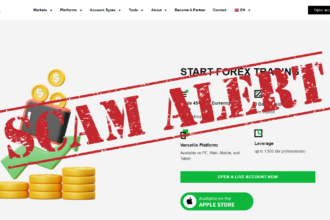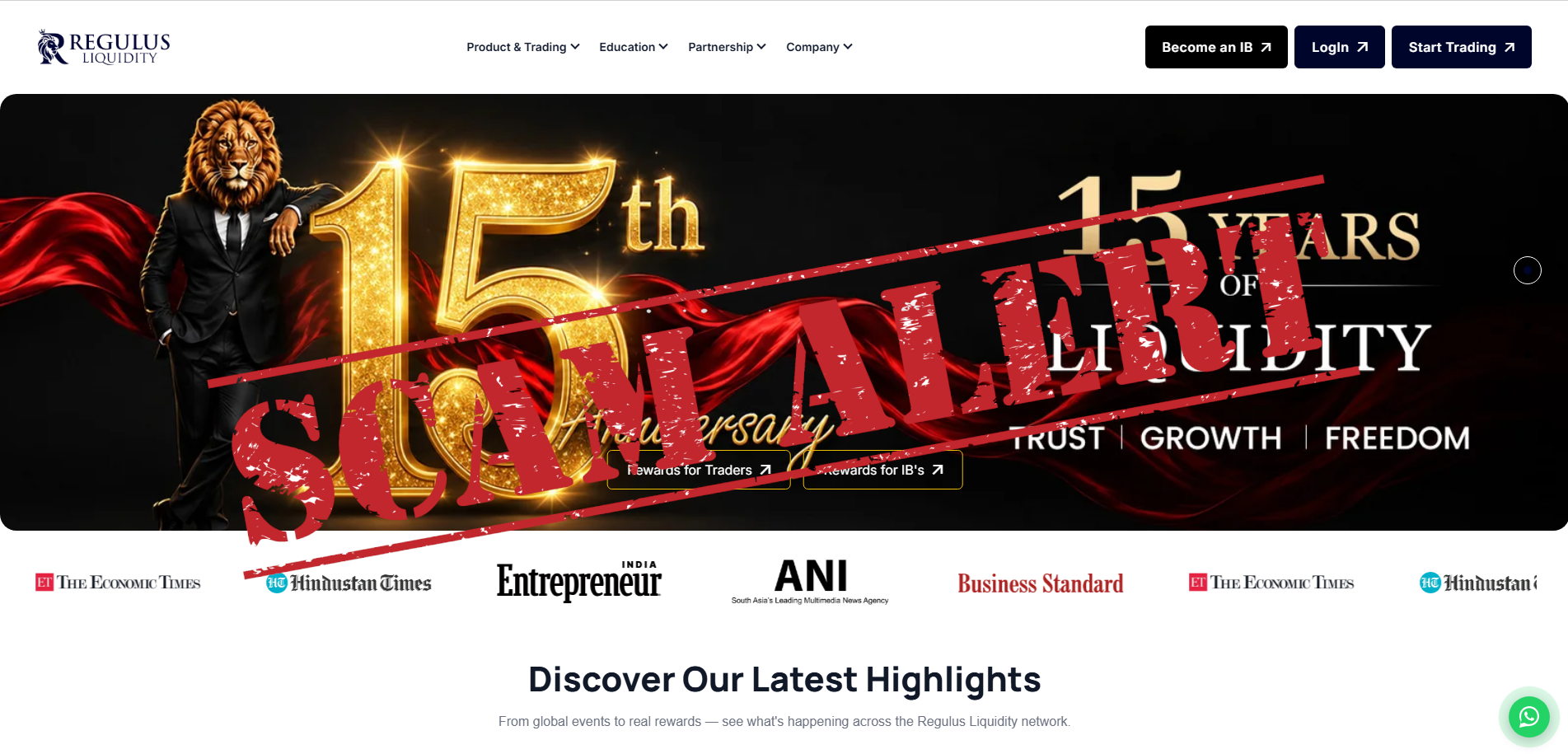
Regulus Liquidity presents itself as both a retail forex/CFD broker and an institutional liquidity provider. The website regulus.org promotes more than 1,200 instruments, MetaTrader 5, spreads from 0.0 pips, maximum leverage of up to 1:1000, several account tiers and what it calls institutional-grade liquidity.
The regulatory picture initially appears reassuring. Regulus Liquidity states that it is regulated by the Financial Services Commission of Mauritius (FSC) under Investment Dealer licence GB23202202, with registration number 205783. (regulus.org)
But a deeper review reveals an important distinction.
Mauritius corporate records identify the registered company as Regulus Capital, file number C205783 — not “Regulus Liquidity.” Official Registrar of Companies material confirms that Regulus Capital exists as a Global Business Company. (Регистрация бизнеса)
Independent checks of the FSC register also identify Regulus Capital as the holder of an Investment Dealer licence, reportedly issued in March 2024. (Traderhelpbook)
That does not automatically mean anything is wrong.
But it creates the first important question for every prospective client:
What is the exact legal relationship between Regulus Capital and the trading brand Regulus Liquidity?
That question becomes much more important when the broker accepts retail deposits, offers leverage up to 1:1000 and reserves the right to investigate and potentially invalidate trading activity it considers abusive.
Regulus Liquidity at a Glance
| Item | What We Found |
|---|---|
| Trading name | Regulus Liquidity |
| Main website | regulus.org |
| Registered company found | Regulus Capital |
| Mauritius company number | C205783 |
| Regulatory licence claimed | GB23202202 |
| Licence type reported | Investment Dealer, Full Service Dealer excluding underwriting |
| Jurisdiction | Mauritius |
| Main platform | MetaTrader 5 |
| Instruments | Forex, CFDs, stocks, indices, commodities, crypto, ETFs |
| Minimum deposit | From $100 |
| Maximum leverage | Up to 1:1000 |
| Premium minimum | $10,000 |
| Crown minimum | $25,000 |
| Public complaints | Yes |
| Major complaint theme | Profit cancellation / “arbitrage” disputes |
| Restricted jurisdictions | US, India and others |
The strongest argument against describing Regulus Liquidity as a completely anonymous scam website is the existence of Regulus Capital in Mauritius corporate records.
But regulatory existence is only one part of broker risk.
1. Regulus Capital Exists — But the Website Primarily Uses Another Name
The Mauritius Registrar of Companies lists:
Regulus Capital — C205783
as a Global Business Company. (Регистрация бизнеса)
Regulus Liquidity, however, markets itself almost exclusively under the commercial name Regulus Liquidity.
The website footer says that “Regulus Liquidity” is regulated by the FSC and quotes registration number 205783 and licence GB23202202. (regulus.org)
This is where legal precision matters.
A customer should be able to identify without ambiguity:
- the legal company accepting the account;
- the company receiving the deposit;
- the company appearing in the Client Agreement;
- the licence holder;
- the party responsible for withdrawals;
- the entity against which a complaint can be filed.
Independent regulatory researchers have raised the same issue, noting that the Mauritius registration belongs to Regulus Capital, while the broker-facing website uses Regulus Liquidity. (Traderhelpbook)
This does not prove misuse of another company’s details.
In fact, other evidence makes a legitimate trading-name relationship plausible: the broker’s Android application identifies the developer as REGULUS CAPITAL and uses the same Mauritius address as the trading website. (Google Play)
Still, for a regulated financial business, the relationship should ideally be explicit rather than something the customer has to reconstruct independently.
2. The Licence Appears Genuine — But It Should Not Be Treated as a Universal Safety Guarantee
Regulus Liquidity repeatedly states that the FSC licence is:
GB23202202
and describes it as a full-service Investment Dealer licence. (regulus.org)
Independent reviews checking the Mauritius regulator report that Regulus Capital received an Investment Dealer (Full Service Dealer, excluding underwriting) licence on March 6, 2024. (Traderhelpbook)
That is a meaningful positive factor.
It means this is not the typical situation where a website simply prints an invented regulator name and random licence number.
However, the existence of a licence does not guarantee:
- profitable trading;
- unrestricted withdrawals;
- protection from high leverage;
- immunity from account disputes;
- identical protections in every country;
- acceptance of every trading strategy;
- reimbursement if a customer breaches contractual trading rules.
Those distinctions become highly relevant when reviewing actual complaints against Regulus Liquidity.
3. Leverage of 1:1000 Is an Extreme Retail-Trading Risk
Regulus openly advertises maximum leverage of 1:1000. (regulus.org)
That figure alone deserves significant attention.
At 1:1000 leverage, a trader controls a position one thousand times larger than the margin posted to support it.
The broker’s own Risk Disclosure acknowledges that forex and CFD trading is highly speculative and that leverage can cause losses to develop quickly — potentially even exceeding the initial deposit. (regulus.org)
| Leverage | Approximate exposure from $1,000 margin |
|---|---|
| 1:30 | $30,000 |
| 1:100 | $100,000 |
| 1:500 | $500,000 |
| 1:1000 | $1,000,000 |
This does not mean a trader must use the maximum available leverage.
But offering 1:1000 radically changes the risk profile of the platform.
A small market move can have a large impact on account equity, margin availability and liquidation risk.
For an inexperienced customer, this should be treated as one of the most important warnings on the entire website.
4. The Broker’s Own Risk Disclosure Says Losses May Exceed the Initial Deposit
This deserves a separate section because it goes beyond the standard phrase “trading involves risk.”
Regulus states that because of leverage, customers may suffer losses rapidly and may potentially exceed the amount originally deposited. (regulus.org)
That means anyone considering the platform should establish whether negative-balance protection applies to their particular account.
A critical question is:
If extreme volatility sends the account below zero, is the customer contractually protected from owing additional money?
If negative-balance protection is not explicitly guaranteed, leverage of 1:1000 becomes substantially more consequential.
This is exactly the type of issue that should be clarified in writing before trading, rather than after an extreme market event.
5. A Serious 2026 Complaint Concerns Cancelled Profits and “Latency Arbitrage”
This is the most significant reputation issue we found.
A trader publicly alleged that after depositing approximately $200 and increasing the account to around $735, the broker blocked the account and accused the client of arbitrage. The complaint states that the profits were not released. (WikiFX)
A similar complaint appears on Trustpilot.
What makes the case particularly important is that Regulus Liquidity responded publicly.
The company did not simply deny that a dispute existed. Instead, it said its Risk Management department investigates unusual trading activity, including patterns associated with latency arbitrage, pursuant to its Terms and Conditions. It also acknowledged that in the particular complaint there had been approximately a week’s delay in communication and that the initial decision had not been accompanied by a sufficiently detailed explanation. (Trustpilot)
That response changes the nature of the issue.
We are no longer dealing merely with an anonymous allegation saying “the broker stole my profit.”
There appears to have been a genuine dispute over whether specific trading activity violated broker rules.
And this raises an extremely important question for active traders:
Exactly which strategies can cause Regulus Liquidity to cancel trades, profits or accounts?
6. The “Arbitrage” Clause May Matter More Than Spreads or Commissions
Many traders choose brokers based on execution speed, spreads and leverage.
But if the broker reserves broad discretion to identify certain profitable trading styles as abusive or as latency arbitrage, the relevant contractual language may be more important than any advertised spread.
Regulus markets itself around low-latency infrastructure, institutional liquidity and fast execution. (regulus.org)
At the same time, its response to a complaint confirms that its Risk Management team evaluates activity for potential latency-arbitrage patterns. (Trustpilot)
There is nothing inherently unusual about a broker prohibiting abusive latency exploitation.
Many trading venues have rules against exploiting stale quotes or technical pricing errors.
The consumer risk lies in how clearly the prohibited behaviour is defined and how disputes are adjudicated.
Before trading algorithms, high-frequency strategies, news trading or very short-term scalping, a client should determine:
- what Regulus defines as latency arbitrage;
- whether ordinary scalping can trigger review;
- whether EAs are allowed;
- whether news trading is permitted;
- whether trades may be retrospectively cancelled;
- whether only profits can be removed or losses can also be corrected;
- how the customer can challenge a Risk Management decision.
Those details are more consequential than marketing claims about execution speed.
7. The Broker’s Response to the Complaint Contains Both a Positive and a Negative Signal
The company’s public response should be evaluated fairly.
The positive side is that Regulus did not ignore the complaint. It provided a compliance explanation and explicitly told the client that an unresolved complaint could be escalated to the Mauritius regulator under licence GB23202202. (Trustpilot)
That is preferable to an anonymous offshore broker with no identifiable complaint channel.
But the same response contains an uncomfortable admission.
Regulus acknowledged that a delay of about a week and a decision without a full supporting breakdown fell below its own expectations. (Trustpilot)
For a financial company, that matters.
If a broker cancels profits or freezes an account over suspected trading-rule violations, the customer should receive:
- the exact trades being challenged;
- timestamps;
- the relevant contractual clauses;
- the evidence of the alleged prohibited technique;
- a formal appeal route.
Anything less creates a major information imbalance between broker and trader.
8. The Public Reputation Is Still Extremely Young
The current Trustpilot profile has only a relatively small number of reviews.
Recent search results show around 22 reviews, with a high overall score, but many of the positive posts are very recent and several reviewers appear to have only one review associated with their profiles. (Trustpilot)
This does not mean the positive reviews are false.
But it does mean the review history is not yet deep enough to serve as strong evidence of a long-term operational reputation.
The broker’s public footprint itself also appears relatively recent.
Independent investigation places incorporation of Regulus Capital in March 2024, while some social-media activity connected to Regulus Liquidity reportedly began much later. (Traderhelpbook)
This produces an unusual contrast:
- the company markets institutional infrastructure;
- it describes itself as a serious liquidity provider;
- it offers premium accounts requiring up to $25,000;
- yet the retail brand has only a short independently observable history.
For a $100 account that may be less important.
For a $25,000 Crown account, it becomes far more significant.
9. The Crown Account’s “6% Annual Dividend on Unused Margin” Deserves Clarification
One of the most unusual features advertised by Regulus is found in the Crown account.
The broker says clients depositing at least $25,000 can receive a 6% annual dividend on unused margin, paid daily. (regulus.org)
That wording deserves close examination.
A trader should ask:
- Is this interest?
- Is it technically a dividend?
- Who pays it?
- From what source is it funded?
- Is the rate fixed?
- Can it be changed unilaterally?
- Does it apply only to free margin?
- Is the balance still considered client money?
- Does accepting the payment change the legal status of the funds?
- What happens if the broker becomes insolvent?
Calling a payment a “dividend” on unused margin is unusual enough that sophisticated clients should request the contractual basis in writing.
The headline rate may look attractive, but the legal treatment of that money matters more than the marketing percentage.
10. There Is a Separate Regulus-Liquidity Website Targeting India Despite a Stated India Restriction
This is potentially one of the more interesting inconsistencies.
Regulus’ own Terms and Conditions and AML pages say the platform does not offer services to citizens or residents of India, along with the United States, Cuba, Iraq, Myanmar, North Korea and Sudan. (regulus.org)
However, another live website using the name Regulus Liquidity, regulusliquidity.org, advertises:
“a dedicated account manager for serious traders in India,”
promotes support in English and Hindi, displays +91 telephone fields and repeats the same FSC licence GB23202202 and registration number 205783. (regulusliquidity.org)
That is an important inconsistency.
It may have an innocent explanation: the second domain could be a regional marketing page, affiliate operation, outdated page, unauthorized clone, or campaign whose legal eligibility changed.
But until the relationship is independently clarified, a potential Indian customer should exercise considerable caution.
If the main legal documentation says:
India is restricted,
while another website using the same brand and licence actively solicits Indian traders, the customer should ask Regulus Compliance for written confirmation that the website is officially authorized and that the customer is legally eligible to open an account.
This is exactly the type of inconsistency regulators repeatedly tell consumers not to ignore.
11. The Broker Markets Itself as Both Retail Broker and Institutional Liquidity Provider
Regulus does more than offer retail trading.
It describes itself as a forex liquidity provider for brokers, offering institutional liquidity, sandbox connectivity, tiered liquidity and infrastructure for connected brokers. (regulus.org)
At the same time, it accepts retail customers from as little as $100 and offers leverage up to 1:1000. (regulus.org)
Again, there is nothing automatically improper about serving both B2B and B2C clients.
But the dual role creates additional questions:
Does Regulus act as principal against retail customers?
Does it internalize trades?
Are orders routed externally?
Who are the liquidity providers?
How are conflicts of interest managed?
What execution model is used for each account type?
Marketing terms such as “institutional liquidity” are not substitutes for a detailed execution policy.
12. “Segregated Funds” Is Not the Same as Investor Compensation
Regulus repeatedly states that client funds are segregated. (regulus.org)
This is positive if implemented as represented.
But traders often misunderstand what segregation means.
Segregated accounts generally refer to separating customer money from company operating funds. That does not automatically mean there is an unlimited government guarantee or investor-compensation fund.
Before making a significant deposit, a customer should verify:
- which bank holds client money;
- whether the account is designated as client money;
- whether funds are held individually or omnibus;
- whether they can be used for hedging;
- what insolvency rules apply;
- whether Mauritius provides a compensation scheme applicable to the account;
- how quickly client assets would be returned if the dealer failed.
A statement saying “segregated client funds” is useful.
It is not the end of the insolvency-risk analysis.
13. Regulus Says Withdrawals Are Fast — But Contractual Rights Matter More Than Marketing
The deposits and withdrawals page says transactions are fast, transparent and processed through verified channels, with no internal deposit or withdrawal fees. (regulus.org)
It also says withdrawals are returned to the original funding source and that KYC/payment documentation may be required.
These are fairly conventional policies.
However, the public arbitrage dispute illustrates why the general withdrawal page does not tell the whole story.
A straightforward withdrawal may be fast.
A withdrawal from an account placed under a Risk Management investigation is a different matter.
For that reason, clients should read not only the “Deposit and Withdrawal” marketing page but also the clauses governing:
- abusive trading;
- pricing errors;
- arbitrage;
- account suspension;
- cancellation of transactions;
- reversal of profits;
- compliance reviews.
The worst time to discover those provisions is after a profitable account has already been flagged.
What Regulators and Official Records Actually Tell Us
The regulatory picture is more nuanced than either promotional material or simplistic scam reviews suggest.
| Question | Finding |
|---|---|
| Is there a Mauritius company with registration 205783? | Yes — Regulus Capital |
| Is the company recent? | Incorporated in 2024 |
| Does Regulus Liquidity claim FSC regulation? | Yes |
| Licence quoted | GB23202202 |
| Licence class reported by independent register checks | Full Service Investment Dealer, excluding underwriting |
| Is the website’s trading name identical to the registered company name? | No |
| Is there evidence linking Regulus Capital to the ecosystem? | Yes, including the mobile app developer identity |
| Does the broker offer very high leverage? | Yes — up to 1:1000 |
| Does its own disclosure acknowledge potential losses beyond initial deposit? | Yes |
| Has a customer alleged profit confiscation? | Yes |
| Did the broker publicly respond to that dispute? | Yes |
| Does Regulus prohibit some forms of arbitrage? | Its response indicates latency-arbitrage investigations |
| Does the main documentation restrict India? | Yes |
| Is another Regulus-branded site targeting India? | Yes |
| Did we find an FSC ruling declaring Regulus Liquidity fraudulent? | No |
This distinction is important.
We found grounds for regulatory and contractual scrutiny.
We did not find grounds to falsely state that the FSC has declared Regulus Liquidity a scam.
Eight Main Risks Around Regulus Liquidity
1. The legal-name distinction.
The registered Mauritius entity is Regulus Capital, while customers primarily encounter Regulus Liquidity.
2. Extreme leverage.
Leverage up to 1:1000 can amplify relatively small market movements into major account losses. (regulus.org)
3. Potential losses beyond the original deposit.
The broker itself warns that losses may exceed initial capital. (regulus.org)
4. Profit-cancellation disputes.
At least one client has publicly alleged that profitable trading was classified as arbitrage and the resulting profits were withheld. (WikiFX)
5. Broker discretion over prohibited strategies.
Regulus confirms that Risk Management reviews suspected latency-arbitrage patterns. (Trustpilot)
6. Short independent operating history.
The underlying company dates only to 2024, while the retail brand’s visible reputation is even newer. (Регистрация бизнеса)
7. Unusual 6% return on unused margin.
The Crown account advertises a 6% annual “dividend” on unused margin, which deserves contractual clarification before a $25,000 deposit is made. (regulus.org)
8. Geographic inconsistency.
The main legal documentation excludes India, while another site using the same brand and licence explicitly markets to Indian traders. (regulus.org)
Is Regulus Liquidity a Scam?
Based on the evidence currently available, it would be inaccurate to describe Regulus Liquidity simply as an anonymous unlicensed scam broker.
There is a real Mauritius company called Regulus Capital with registration number C205783. Official Mauritius corporate material confirms its existence. (Регистрация бизнеса)
Independent checks also report a genuine Investment Dealer licence associated with Regulus Capital. (Traderhelpbook)
However, that does not eliminate the risks.
The platform offers unusually high leverage, warns that losses may exceed deposited capital, operates under a trading name different from the registered company name and has already faced at least one significant public dispute involving alleged profit cancellation.
Most importantly, Regulus itself confirmed that it can investigate trading patterns associated with latency arbitrage.
For algorithmic traders, scalpers and clients using fast execution strategies, this is not a minor contractual detail.
It may determine whether profitable trades are ultimately recognized.
Final Verdict: Is Regulus Liquidity Safe?
Regulus Liquidity appears to have a genuine Mauritius corporate and regulatory foundation, but that should not be confused with a low-risk trading environment.
The strongest positive factors are the existence of Regulus Capital, the reported FSC Investment Dealer licence, a recognizable corporate address and the broker’s willingness to publicly respond to a customer dispute.
The strongest concerns are very different:
1:1000 leverage, a short public track record, ambiguity between the Regulus Capital legal entity and Regulus Liquidity trading name, a documented dispute over alleged latency arbitrage, and an apparent contradiction between India being listed as a restricted jurisdiction and another Regulus-branded site actively targeting Indian customers.
For a prospective customer, especially one considering a Premium or $25,000 Crown account, checking the licence number is therefore only the first step.
Before funding regulus.org, we would request written confirmation of five points:
- Is Regulus Capital C205783 the exact contractual counterparty for my account?
- Is my country specifically permitted under the company’s FSC-authorized business model?
- Which trading strategies can result in profits being cancelled or reversed?
- Does negative-balance protection apply to my account despite leverage up to 1:1000?
- What exactly is the legal and financial basis of the advertised 6% annual dividend on unused margin?
A genuine licence answers an important question.
It does not remove execution risk, leverage risk, contractual risk or the possibility of disputes over how profitable trading strategies are classified.
Brokers Verdict assessment: Regulus Liquidity has a verifiable Mauritius corporate footprint and an apparently genuine regulatory connection, but several contractual, leverage, transparency and jurisdictional issues justify a medium-to-high level of caution before depositing substantial funds.
Lost money with a broker? Find out how to get it back! Contact us at [email protected], leave your name and phone number so we can get back to you. The Watchdog Online team stands guard over your safety — together we will make the Internet better!