A financial licence can be reassuring. It can also create a dangerous shortcut in an investor’s thinking: the company is regulated, therefore everything connected with it must be safe.
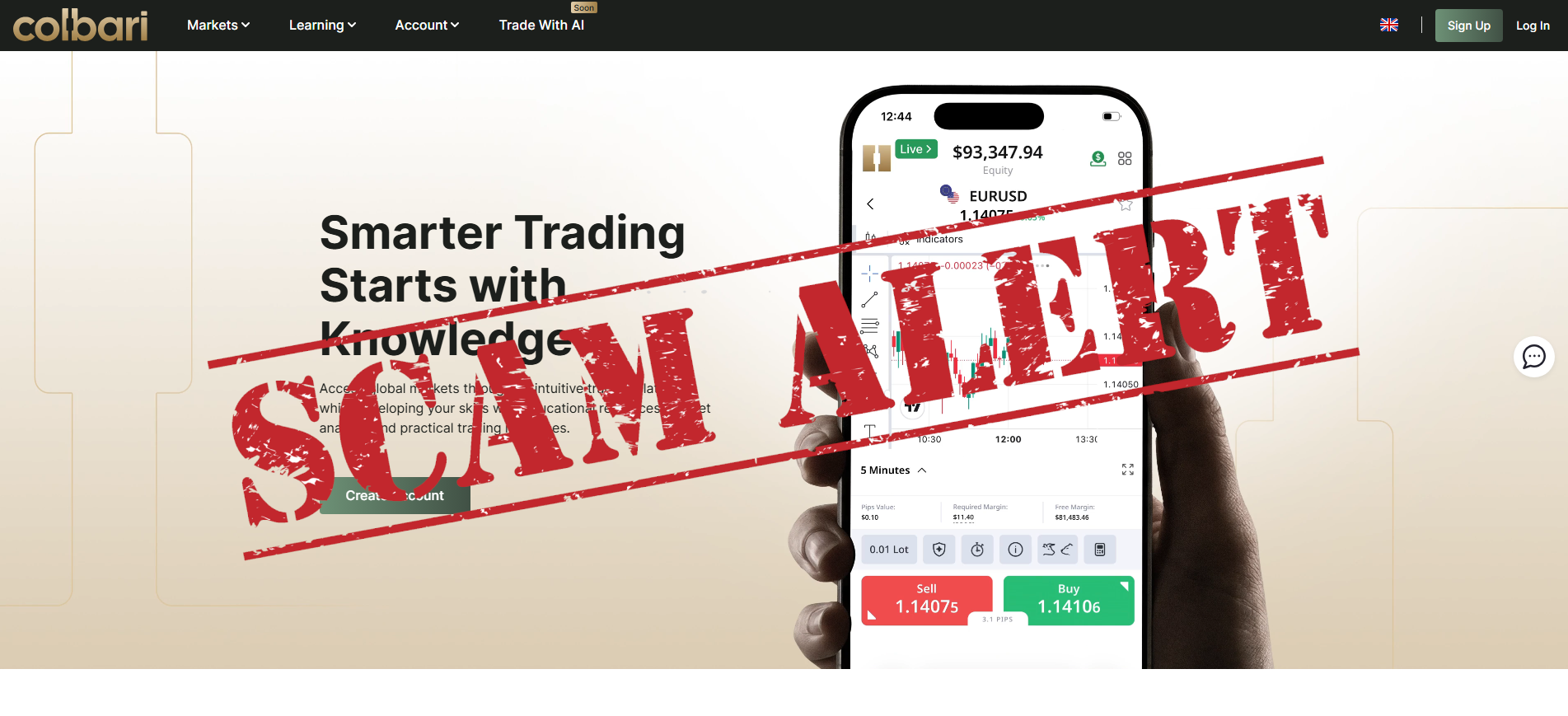
The case of Colbari, operating through colbari.com, is more complicated.
Our review found that the company behind the brand, Valor Capital (PTY) Ltd, does have a verifiable regulatory footprint in South Africa. The Financial Sector Conduct Authority (FSCA) lists VALOR CAPITAL LTD under FSP number 51822, Category I, with permissions covering advice and intermediary services.
That fact is important. Colbari should therefore not simply be described as an anonymous broker using a completely fabricated licence.
But it does not end the investigation.
A closer examination of the regulator’s information, Colbari’s own legal documents, geographical restrictions, CFD risk disclosures and the complaints now appearing online reveals several issues that prospective traders should understand before depositing money.
Colbari at a Glance
| Item | What We Found |
|---|---|
| Trading brand | Colbari |
| Website | colbari.com |
| Operating company | Valor Capital (PTY) Ltd |
| Jurisdiction | South Africa |
| Company registration claimed | 2021/547363/07 |
| Regulator | FSCA |
| FSP number | 51822 |
| FSCA category found | Category I |
| Authorised activities shown by FSCA | Advice / Intermediary services |
| Product offered | Primarily leveraged CFDs |
| Maximum leverage reported | Up to 1:400 |
| Restricted regions disclosed | EEA, USA, Russia and others |
| Brand/web history | Considerably newer than the legal entity |
| Recent customer complaints | Yes |
The most important conclusion at this stage is therefore not “Colbari has no regulation.”
The better question is:
What exactly does its South African regulatory status protect a Colbari customer from — and what does it not protect them from?
1. The FSCA Licence Exists — But Its Scope Matters
This is the first point where many superficial Colbari reviews go wrong.
The FSCA’s published list of authorised Crypto Asset Service Providers contains VALOR CAPITAL LTD, FSP 51822, classified as Category I. The listed activities are “Advice” and “Intermediary services.”
Colbari’s own Client Agreement similarly states that Valor Capital (PTY) Ltd is regulated by the FSCA under FSP 51822 “to provide intermediary service.”
Valor Capital’s corporate website independently identifies Colbari as a brand that it owns and operates.
So there is a real regulatory connection.
However, investors should not interpret the existence of an FSP number as an unlimited guarantee covering every possible activity, product, jurisdiction or customer relationship.
Financial licences have defined scopes.
A consumer should therefore verify not merely:
“Does FSP 51822 exist?”
but also:
“Does the authorisation cover the precise service, product and relationship being offered to me?”
That distinction becomes especially relevant when highly leveraged CFDs are involved.
2. Colbari Itself Warns That Clients Can Lose Their Entire Balance
One of the strongest risk warnings does not come from a hostile review site.
It comes from Valor Capital itself.
The company’s disclosure states that CFDs are complex speculative products and that margin trading can result in the loss of a trader’s entire balance. Valor Capital also explicitly warns that leverage can work both for and against the customer.
That disclosure deserves far more attention than promotional language about trading opportunities.
Colbari has been reported as offering leverage as high as 1:400.
At that level, relatively small adverse price movements can have a disproportionate impact on account equity.
| Issue | Potential consequence |
|---|---|
| Leveraged CFDs | Losses amplified relative to deposited margin |
| Leverage up to 1:400 | Very high sensitivity to price movements |
| Margin requirements | Positions may require additional capital |
| Overnight positions | Financing/swap costs can accumulate |
| Rapid volatility | Equity can deteriorate quickly |
| CFD structure | Trader does not own the underlying asset |
The fact that a broker is regulated does not remove market or leverage risk.
And this becomes more significant when compared with what some Colbari customers say happened to their accounts.
3. The Company’s Own Documents Exclude Major Jurisdictions
There is another detail that deserves careful attention.
Valor Capital’s Client Agreement states that its website, services and products are not intended for residents of the European Economic Area, the United States, British Columbia in Canada, Russia, Iran, North Korea, Myanmar and certain other jurisdictions.
The Valor Capital corporate website repeats substantially the same regional restrictions.
This has an important practical implication.
A trader should not assume that a South African FSP authorisation automatically gives Colbari permission to solicit customers everywhere in the world.
Local authorisation and cross-border authorisation are different questions.
The UK’s FCA, for example, tells consumers that almost all firms conducting regulated financial business in the UK must be authorised or registered there and advises consumers to check the Firm Checker for the particular service being offered. It also warns that the absence of a firm from its Warning List does not itself establish that the firm is authorised.
Colbari’s explicit EEA restriction is therefore particularly important for European consumers.
If somebody residing in a restricted jurisdiction receives an approach allegedly connected with Colbari, the sensible question is not simply whether FSP 51822 exists.
It is:
Why am I being approached if the company’s own legal documents say that its services are not intended for residents of my jurisdiction?
That is a substantially more useful regulatory question.
4. The Legal Entity Is Older Than the Colbari Brand
Another point deserves clarification.
Valor Capital gives its South African registration number as 2021/547363/07.
Colbari, however, appears to be a much newer trading brand. Independent broker databases place its establishment around 2025. Forex Peace Army, for example, currently describes Colbari as established in 2025.
There is nothing inherently suspicious about an established legal entity launching a new brand.
But the distinction matters when evaluating claims about experience.
A company’s incorporation date should not automatically be treated as the operating history of every brand it later launches.
For due diligence, investors should separate three dates:
- incorporation of Valor Capital;
- authorisation of the relevant financial-services entity;
- actual launch and operating history of Colbari.com.
A four-year-old legal entity does not automatically give a newer trading platform four years of customer-facing brokerage history.
5. Another Website Is Using the Same Valor Capital Regulatory Identity
This is one of the more unusual findings.
Colbari is not the only website currently presenting itself as being operated by Valor Capital.
CFI Trade states that it is operated by Valor Capital (PTY) Ltd, provides the same FSP number 51822, gives registration number 2021/547363/07, and states that Valor Capital owns and operates the CFI Trade brand.
Another website, FXTRADENEST, also claims to be operated by Valor Capital under FSP 51822. But its footer gives the registration number as:
2023/547363/07
rather than:
2021/547363/07.
That discrepancy does not prove misconduct by Colbari or Valor Capital. It could have an innocent explanation, including a website error.
Nevertheless, regulatory identifiers exist precisely so that customers can determine who they are contracting with.
When multiple trading websites use the same regulated company’s identity — and one displays inconsistent corporate information — investors should verify the relationship directly through authoritative sources rather than assuming that every website displaying FSP 51822 is automatically covered by the same authorisation.
This is also consistent with general regulator advice about checking the identity of financial firms rather than relying on licence numbers displayed on websites.
6. Colbari Says It Is Not a Financial Adviser
There is another potentially important sentence in Valor Capital’s disclosures.
The company states that it:
does not issue advice, recommendations or opinions regarding acquiring, holding or disposing of financial products and is not a financial adviser.
On its face, that is straightforward.
But it becomes highly relevant when considered alongside certain customer complaints.
Several reviewers allege that Colbari representatives did much more than provide technical customer support.
One May 2026 reviewer alleged that managers discussed swap adjustments and requested further deposits before account issues could supposedly be corrected. Another alleged being repeatedly encouraged to add more money before the account balance eventually fell dramatically. These are unverified customer allegations rather than regulatory findings, and they should be treated accordingly.
A more detailed complaint appeared in August 2026.
The customer alleges that after transactions totalling $7,750, an account manager called frequently, pressured him to make further deposits and gave instructions about his trading activity. The same allegations were subsequently posted on Forex Peace Army.
Again, these statements have not been established by a regulator or court in the sources we reviewed.
But they raise a legitimate compliance question:
If company representatives are providing customers with specific instructions about trades, does that activity remain consistent with the company’s statement that it does not provide financial advice or recommendations?
That is exactly the kind of issue a regulator — rather than an anonymous review website — would be best placed to determine.
7. Customer Complaints Show a Repeated Pattern Worth Monitoring
Individual online reviews are unreliable evidence.
Some are genuine. Some can be exaggerated. Some may be impossible to verify, and financial-review platforms are also vulnerable to manipulation from both positive and negative contributors.
Therefore, we would not call Colbari fraudulent simply because somebody posted a one-star review.
What deserves attention is the pattern.
Recent negative reviews contain recurring allegations concerning:
- repeated telephone contact;
- pressure to deposit additional money;
- account-manager involvement in trading decisions;
- requests for further funds after losses;
- disputes involving swaps;
- substantial deterioration of account balances;
- withdrawal or settlement disputes.
The August complaint is particularly detailed because the customer identifies Valor Capital/Colbari, gives a transaction date and amount, and describes an alleged dispute over settlement following losses.
These remain allegations.
But when the same themes begin appearing independently, prospective customers have a reasonable basis to investigate them before funding an account.
8. Regulation Does Not Mean Investor Compensation Is Guaranteed
This distinction is frequently overlooked in online broker advertising.
A regulated entity and an investor-compensation arrangement are not synonymous.
Before depositing with any cross-border CFD provider, customers should establish:
- how client money is held;
- whether it is segregated from operational funds;
- which legal entity receives deposits;
- which bank or payment provider is involved;
- whether negative-balance protection applies;
- whether an investor-compensation scheme applies;
- which ombudsman or dispute-resolution mechanism has jurisdiction;
- what happens if the company becomes insolvent.
Colbari’s marketing materials say client balances are maintained separately from company operations.
That is a useful statement, but investors should distinguish a company’s disclosure from a statutory compensation guarantee.
The practical question is not simply “are funds segregated?” but what legally enforceable protection applies to my specific account if something goes wrong?
9. The Payment-Agent Structure Deserves Attention
Colbari’s published material identifies Dunfold Ltd, with a London address, as a payment agent for Valor Capital.
This is another area where customers should understand the transaction chain before sending money.
If a trader signs an agreement with a South African entity but sends money through another company or payment agent, several questions become important:
Who legally receives the money? Who holds it? What appears on the bank/card statement? What contractual relationship exists between the payment agent and the regulated company? Which jurisdiction applies if a payment dispute occurs?
Use of a payment agent is not inherently improper.
But cross-border payment arrangements increase the importance of knowing exactly which company is responsible at each stage.
10. What the Regulators Actually Tell Us
This investigation produced a more nuanced result than many online “scam broker” reviews.
| Regulatory question | Finding |
|---|---|
| Is FSP 51822 completely fictitious? | No |
| Does FSCA material identify Valor Capital? | Yes |
| FSCA category | Category I |
| Activities shown in FSCA material | Advice / Intermediary services |
| Does Valor Capital identify Colbari as its brand? | Yes |
| Does the Client Agreement connect colbari.com with Valor Capital? | Yes |
| Does that automatically authorise the broker worldwide? | No |
| Does Colbari restrict EEA/US/Russian residents? | Yes |
| Does regulation eliminate CFD risk? | No |
| Is there evidence here of an FSCA fraud finding against Colbari? | We did not find one |
| Are there recent serious customer allegations? | Yes |
This table is important because it prevents two opposite mistakes.
The first is saying:
“Colbari has no licence.”
The evidence we found does not support that statement.
The second is saying:
“Colbari is FSCA-regulated, therefore there is nothing to worry about.”
The evidence does not justify that conclusion either.
11. Seven Risks to Check Before Using Colbari.com
The principal concerns identified during this investigation are:
1. Very high leverage.
Reported leverage of up to 1:400 can make CFD losses develop extremely quickly.
2. Cross-border regulatory limitations.
The company’s own agreement excludes the EEA, USA, Russia and other territories.
3. Licence scope should be verified, not assumed.
FSCA material identifies FSP 51822 as Category I and lists advice/intermediary activities.
4. A relatively young trading brand.
The Colbari operation appears substantially newer than the company whose 2021 registration underpins it.
5. Multiple websites associated with the same FSP identity.
CFI Trade and FXTRADENEST currently publish Valor Capital/FSP 51822 details, while FXTRADENEST displays a different year in the corporate registration number.
6. Complaints alleging aggressive account-management practices.
Recent customers have alleged pressure to increase deposits and significant involvement by account managers. These allegations remain unproven.
7. Potential tension between complaints and published policy.
Valor Capital states that it does not provide financial advice or recommendations, making allegations of trade-specific instructions particularly relevant if they can be independently substantiated.
Is Colbari a Scam?
Based on the regulatory evidence reviewed, we would not describe Colbari as an unlicensed scam broker.
Doing so would ignore an important fact: Valor Capital has an identifiable FSCA regulatory status, FSP 51822, and Valor Capital publicly identifies Colbari as its brand.
But a licence is not the end of due diligence.
Colbari remains a relatively young CFD brand offering highly leveraged products. Its own legal documents impose significant territorial restrictions, its corporate/regulatory identity appears across multiple trading websites, and recent customers have published serious allegations concerning sales pressure, additional deposits, account-management practices and losses.
None of those customer allegations should be presented as proven misconduct without regulatory or judicial findings.
They are nevertheless relevant warning signals.
Final Verdict: Can You Trust Colbari?
The most accurate conclusion is more uncomfortable than either “safe” or “scam.”
Colbari has a verifiable regulatory connection, but there are still material risks that prospective traders should investigate.
The existence of FSCA FSP 51822 should be acknowledged. Equally, customers should verify the exact scope of that authorisation, their own jurisdictional eligibility, the treatment of client money, the role of payment agents, leverage and swap conditions, and whether any representative who contacts them is acting consistently with Valor Capital’s published regulatory obligations.
Most importantly, anyone approached by a Colbari representative should preserve written records of recommendations, deposit requests and trading instructions.
If an account manager recommends particular trades, repeatedly asks for additional deposits, promises that adding money will rescue a losing account, or communicates important financial conditions only by telephone, the customer should request those statements in writing before taking further action.
A real FSP number answers one question.
It does not answer every question about how a broker treats its clients.
Sources used for the regulatory review
The principal regulatory source is the Financial Sector Conduct Authority (FSCA) register/search service and the FSCA’s published list showing Valor Capital under FSP 51822.
For the contractual relationship and territorial restrictions, we reviewed the Valor Capital / Colbari Client Agreement and Valor Capital corporate information.
Customer allegations were cross-checked against Colbari reviews on Trustpilot and the recent Valor Capital / Colbari complaint on Forex Peace Army. These customer reports are treated as allegations, not regulatory findings.
Lost money with a broker? Find out how to get it back! Contact us at [email protected], leave your name and phone number so we can get back to you. The Watchdog Online team stands guard over your safety — together we will make the Internet better!