A few years ago, online investment schemes were built around:
- Forex robots;
- cloud mining;
- crypto arbitrage;
- and “secret trading algorithms.”
In 2026, the narrative changed.
Now the most fashionable buzzwords are:
- AI infrastructure;
- GPU clusters;
- NVIDIA H100;
- machine learning;
- distributed computing;
- inference workloads;
- and monetizing unused GPU capacity.
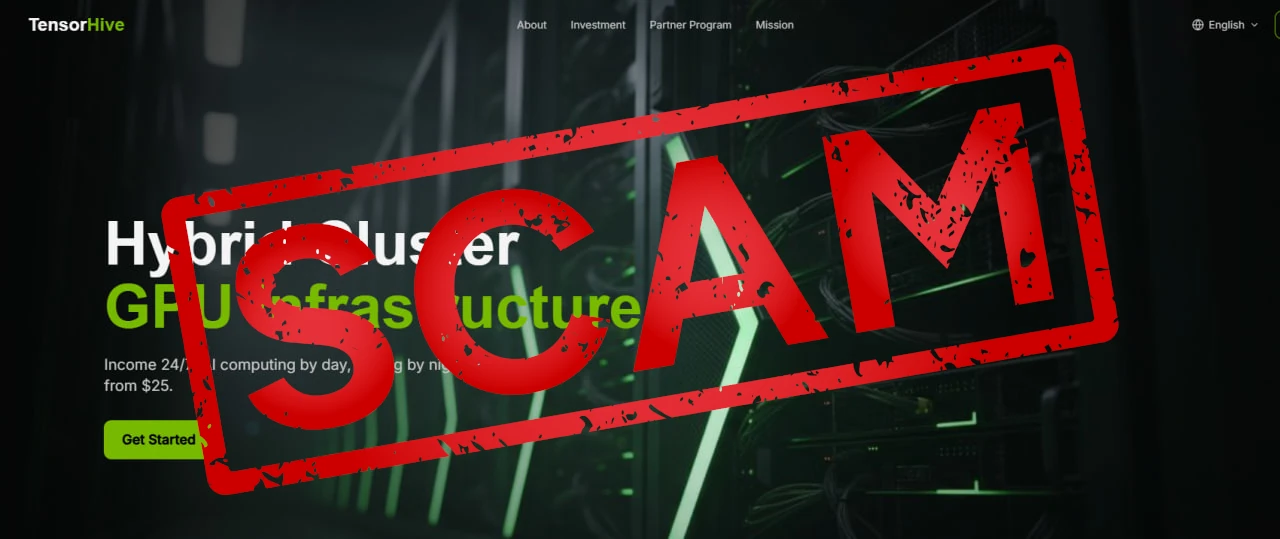
That is exactly how TensorHive.io presents itself.
The platform claims to operate a sophisticated ecosystem where:
- GPUs are rented for AI workloads during the day;
- and automatically switched to crypto mining at night.
On the surface, it sounds highly technological.
The problem is that once the platform’s economics, infrastructure claims, referral mechanics, licensing status, and operational structure are examined, TensorHive.io begins to resemble not a real AI infrastructure company, but a modernized HYIP/Ponzi-style operation wrapped in AI and GPU terminology.
Most importantly, the Central Bank of Russia has already added TensorHive.io to its official warning list with signs of a financial pyramid.

General information about TensorHive.io
| Parameter | Details |
|---|---|
| Domain | tensorhive.io |
| Registered | April 1, 2026 |
| Registration period | 1 year |
| Registrar | HOSTINGER operations, UAB |
| Business model | AI/GPU HYIP |
| Claimed ROI | Up to 7% daily |
| Payout currency | USDT |
| Referral system | 15% / 5% / 3% |
| Central Bank of Russia | Financial pyramid warning |
| FCA/CySEC/MAS regulation | Not confirmed |
| Risk level | Extremely high |
The Central Bank of Russia already flagged TensorHive.io
This is one of the strongest facts in the entire investigation.
Official warning:
https://www.cbr.ru/eng/inside/warning-list/detail/?id=43988
The regulator explicitly identified:
signs of a financial pyramid.
This is no longer just:
- forum speculation;
- anti-scam blogs;
- or anonymous complaints.
This is an official warning from a national financial regulator.
That alone significantly increases the platform’s risk profile.
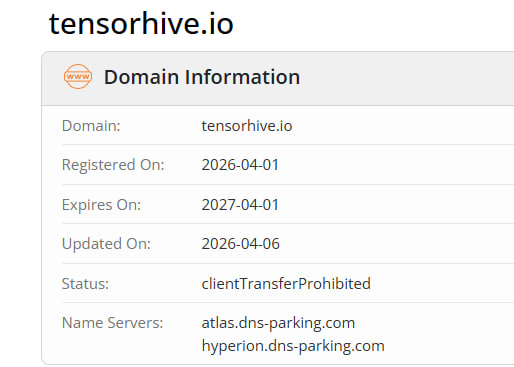
WHOIS and infrastructure analysis of TensorHive.io
WHOIS records show:
- Registered On: 2026-04-01
- Expires On: 2027-04-01
This means:
- the domain is extremely new;
- and registered for only one year.
For a company claiming to operate:
- AI infrastructure;
- GPU compute farms;
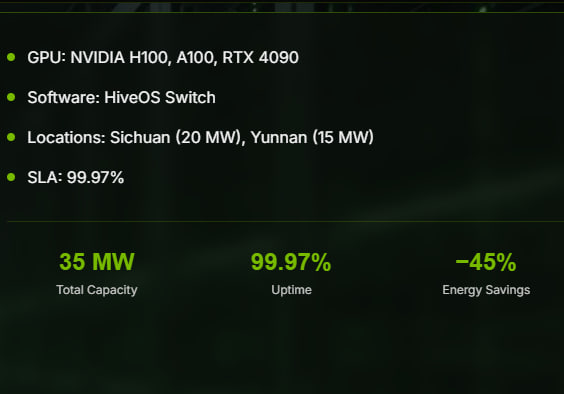
- NVIDIA H100 and A100 clusters;
- 35 MW of computing capacity;
- and global-scale workloads,
this infrastructure looks surprisingly cheap and temporary.
The platform relies on:
- Hostinger hosting;
- standard cloud deployment patterns;
- and generic infrastructure components.
This is highly unusual for a supposedly large-scale AI compute ecosystem.
TensorHive.io promises up to 7% daily returns
This is where the investigation becomes especially important.
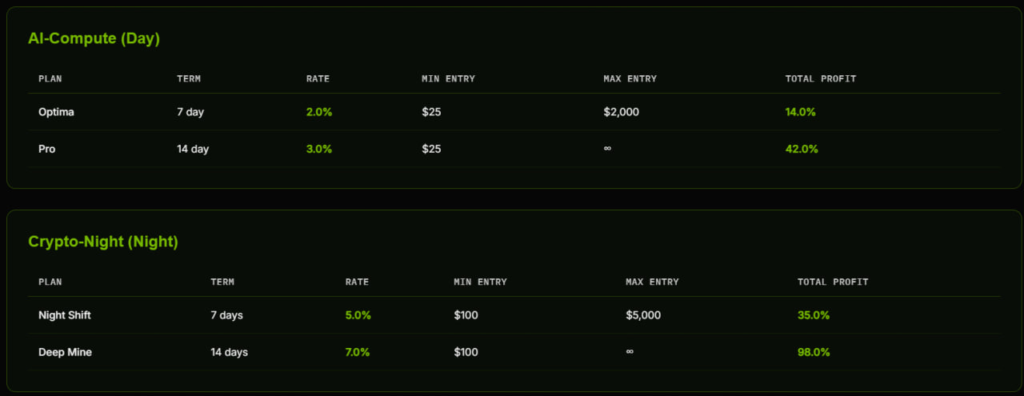
The platform advertises several investment plans:
- Optima;
- Pro;
- Night Shift;
- Deep Mine.
Claimed profitability:
- 2% daily;
- 3% daily;
- 5% daily;
- up to 7% daily.
One plan specifically advertises:
7% daily for 14 days.
The website itself calculates:
total profit: 98%.
In practice, users are effectively promised:
nearly double their money within two weeks.
This is textbook HYIP mathematics.
Mathematical analysis of TensorHive.io
Let’s examine the numbers.
7% daily ROI
Without compounding:
- approximately 210% monthly return;
- thousands of percent annually.
With compound growth included, the numbers become mathematically extreme.
No:
- AI infrastructure company;
- GPU cloud provider;
- hedge fund;
- quantitative trading firm;
- data-center operator;
- or crypto mining business
can sustainably provide this level of guaranteed daily profitability to mass-market investors.
Especially:
- every single day;
- through fixed payouts;
- in USDT;
- and supposedly with low operational risk.
This type of return structure is one of the clearest indicators of Ponzi-style economics.
The AI/GPU narrative appears primarily marketing-driven
TensorHive.io heavily relies on references to:
- NVIDIA H100;
- NVIDIA A100;
- RTX 4090;
- AI workloads;
- HiveOS switching;
- GPU monetization;
- and compute infrastructure.
This is a very effective modern scam narrative.
Why?
Because most users:
- do not understand GPU economics;
- cannot verify infrastructure claims;
- and associate AI hardware with cutting-edge technology and large institutional value.
The platform repeatedly references:
“35 MW GPU infrastructure”
Yet no independently verifiable evidence is provided:
- no data-center disclosures;
- no enterprise clients;
- no infrastructure audits;
- no independent capacity verification;
- no operational transparency;
- no proof of GPU ownership.
The AI/GPU ecosystem narrative therefore functions primarily as a marketing wrapper.
“Lloyd’s of London insurance” raises additional concerns
The website claims:
“insured by Lloyd’s of London.”
This is an extremely serious statement.
However:
- no policy number is provided;
- no underwriter is identified;
- no verification exists;
- and no independent confirmation is available.
HYIP and Ponzi-style investment projects frequently reference:
- Lloyd’s insurance;
- Swiss banking;
- Singapore infrastructure;
- insured assets;
- and institutional partnerships
to create artificial credibility.
Without verifiable documentation, these claims remain highly questionable.
TensorHive.io uses MLM-style referral mechanics
The platform also includes:
- a referral program;
- 15% level-one commissions;
- 5% level-two commissions;
- 3% level-three commissions.
Additional “rank” systems include:
- Dragon levels;
- structure volume targets;
- recruitment rewards;
- and affiliate bonuses.
One example shown on the platform:
“Dragon Master – structure volume $1,000,000.”
This structure resembles:
- MLM mechanics;
- recruitment-driven growth;
- affiliate Ponzi infrastructure;
- and network-marketing style expansion.
Real AI infrastructure businesses do not normally operate through aggressive multi-level referral systems.
“Singapore jurisdiction” without MAS regulation
The platform references:
- Singapore jurisdiction;
- Hong Kong/Singapore payouts.
However:
- no MAS authorization was identified;
- no Singapore financial licensing appears verified;
- no transparent UEN disclosure exists.
This suggests that “Singapore” functions primarily as a prestige-label rather than a verified regulatory jurisdiction.
HYIP-monitoring websites already classify TensorHive.io as HYIP
TensorHive.io already appears on:
- https://h-metrics.com/project/tensorhive.io/
- https://instant-monitor.com/Projects/Details/tensorhive.io
- https://investors-protect.com/hyip/tensorhive.io
This is highly significant.
These are not:
- institutional fintech directories;
- venture-capital platforms;
- or AI infrastructure marketplaces.
These websites specifically monitor:
- HYIP projects;
- high-yield investment programs;
- Ponzi operations;
- and crypto passive-income schemes.
Real GPU infrastructure economics look very different
Even major GPU infrastructure providers such as:
- CoreWeave;
- Lambda Labs;
- Vast.ai;
do not promise fixed 5–7% daily returns to retail investors.
The real AI infrastructure market involves:
- high operational costs;
- volatile demand;
- expensive energy usage;
- hardware depreciation;
- and highly competitive margins.
That makes TensorHive’s profitability claims especially difficult to justify from a realistic business perspective.
How projects like TensorHive.io typically operate
The operational pattern is highly recognizable.
Initially:
- users see stable profits;
- receive small payouts;
- trust the platform;
- and increase deposits.
Later:
- referral recruitment intensifies;
- larger investments are encouraged;
- withdrawal delays begin;
- support quality declines;
- or the platform enters “maintenance.”
This lifecycle is extremely common among HYIP/Ponzi ecosystems.
TensorHive.io scam or legitimate?
From a legal perspective, only courts and regulators can issue final conclusions.
However, the observable facts are highly concerning:
- up to 7% daily ROI;
- official Central Bank pyramid warning;
- MLM referral mechanics;
- unverifiable infrastructure claims;
- missing regulation;
- disposable infrastructure;
- AI/GPU marketing narratives without evidence;
- and HYIP-monitor ecosystem presence.
For financial analysts, this combination already places the project into an extremely high-risk category.
Final verdict

TensorHive.io demonstrates multiple characteristics commonly associated with modern AI-wrapped HYIP/Ponzi schemes:
- unrealistic daily returns;
- recruitment-driven mechanics;
- questionable infrastructure claims;
- fake institutional credibility signals;
- and aggressive passive-income marketing.
The project attempts to combine:
- AI hype;
- GPU terminology;
- crypto payouts;
- and referral-based growth
into a structure that strongly resembles a modernized investment pyramid rather than a transparent AI infrastructure company.
Our experts recommend avoiding any financial interaction with this platform.
Years ago, Ponzi schemes sold “secret trading robots.”
Today they sell AI, GPU compute power, and machine-learning infrastructure.
But the mathematics behind the schemes remains exactly the same.
Lost money with a broker? Find out how to get it back! Contact us at [email protected], leave your name and phone number so we can get back to you. The Watchdog Online team stands guard over your safety — together we will make the Internet better!
Read also: https://watchdog-online.com/reviews/halatradmac-scam-review-risk-analysis/
https://watchdog-online.com/reviews/evoltex-org-investment-scam-review/