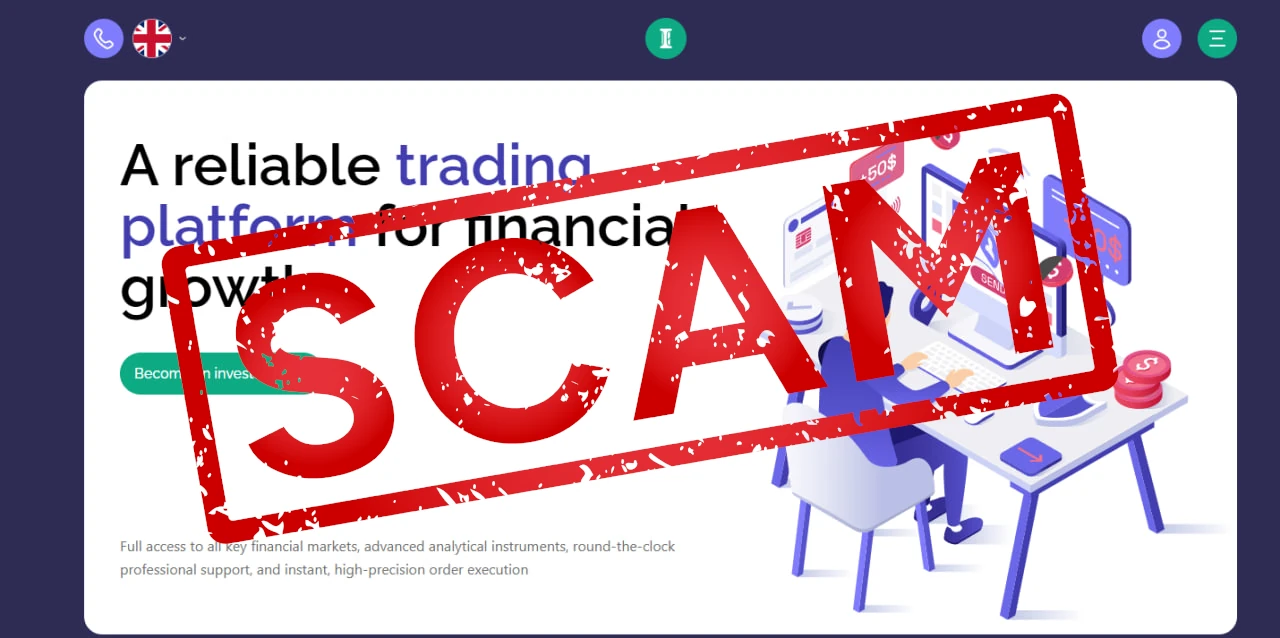
There is a moment when fraudulent broker networks become impossible to unsee.
At first, the similarities look accidental.
Then they start looking suspicious.
And eventually you realize that the same infrastructure keeps appearing again and again:
- identical trading dashboards;
- identical CFD packages;
- identical VIP account structures;
- identical “international licenses”;
- Argentinian addresses;
- mirror domains;
- and the same withdrawal story involving a mysterious “13% tax”.
That is exactly what is happening with Isladova.com.
At first glance, the platform attempts to present itself as a modern international CFD and crypto broker offering:
- Forex trading;
- cryptocurrencies;
- indices;
- commodities;
- metals;
- leverage trading;
- VIP accounts;
- analytics;
- and “professional” investment infrastructure.
The website uses institutional-style language, compliance sections, risk disclosures, and licensing references designed to create credibility.
However, once the licensing claims, infrastructure, domain history, complaints, and operational behavior are investigated, the picture changes dramatically.
The investigation reveals:
- fake regulator infrastructure;
- clone-network characteristics;
- mirror domains;
- withdrawal extortion patterns;
- simulated trading indicators;
- and a recurring “13% tax” scheme repeatedly mentioned by users.
Most importantly, the review of official regulatory registers does not confirm the existence of any license.

General information about Isladova.com
| Parameter | Details |
|---|---|
| Domain | isladova.com |
| Mirror domain | isla-dova.vip |
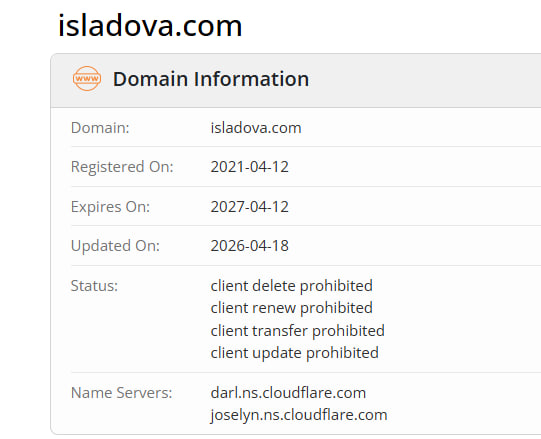
| Original registration | April 12, 2021 |
| WHOIS update | April 18, 2026 |
| Registrar | GoDaddy.com, LLC |
| Infrastructure | Cloudflare |
| Claimed business model | CFD / crypto broker |
| FCA authorization | Not found |
| CySEC authorization | Not found |
| DFSA/FSA/CSSF/VFSC claims | Highly questionable |
| Risk level | Extremely high |
At first glance, the domain appears relatively old.
But this is a very common misconception in scam investigations.
Fraudulent broker networks frequently:
- purchase aged domains;
- recycle expired websites;
- repurpose inactive domains;
- and relaunch them under new branding.
The key issue is not when the domain itself was originally created.
The key issue is when the current broker operation began appearing online.
And complaints related to Isladova.com started growing aggressively only during 2026.
WHOIS and domain analysis of Isladova.com
WHOIS records show:
- Registered On: 2021-04-12
- Updated On: 2026-04-18
This timing is highly interesting.
Aged-domain strategies are commonly used in:
- fake broker operations;
- disposable CFD platforms;
- clone investment schemes;
- and high-risk crypto funnels.
The reason is simple:
older domains can appear more trustworthy to inexperienced users and sometimes receive less aggressive automated risk scoring.
However, the actual broker infrastructure connected to Isladova.com appears significantly newer than the original domain registration date.
Isladova.com follows a recognizable “Argentinian clone broker” pattern
The website lists the following address:
Alvear Bis 104, Rosario, Santa Fe, Argentina
Phone number:
+54 9 341 2605-7841
For ordinary users, this may look like normal international broker information.
For OSINT investigators, however, this pattern is becoming increasingly recognizable.
Very similar structures previously appeared in:
- Norvaninel;
- Seocolv;
- Yozarest;
- and multiple other pseudo-broker operations.
Repeated elements include:
- Argentinian contact details;
- identical licensing narratives;
- CFD/crypto templates;
- mirror domains;
- fake regulators;
- and identical withdrawal scenarios.
This no longer looks random.
It resembles serial infrastructure.

Regulatory verification of Isladova.com
The review of official regulatory registers does not confirm the existence of any license.
No verified authorization was identified in:
- FCA UK
https://register.fca.org.uk/ - CySEC
https://www.cysec.gov.cy/ - FINMA Switzerland
https://www.finma.ch/en/authorisation/ - ASIC Australia
https://asic.gov.au/
At the same time, the platform references:
- https://cert-ssf.org/01774136
- https://vfinsc.org/firm-304059
- https://dubai-cert-register.org/firm-876027
- https://fsa-regulation-uk.net/firm-288702
And this is where the investigation becomes especially important.
Isladova.com appears to use fake regulator infrastructure
The referenced “regulatory” websites display characteristics commonly associated with pseudo-regulator networks.
Particularly:
- fsa-regulation-uk.net
- dubai-cert-register.org
attempt to imitate:
- FCA/FSA UK;
- DFSA Dubai;
- international compliance registries.
However, these are not official government financial regulators.
This type of infrastructure frequently appears in:
- clone broker operations;
- HYIP schemes;
- fake investment platforms;
- pseudo-crypto exchanges;
- and offshore boiler-room networks.
A polished “certificate” on an unknown website is not equivalent to financial authorization.
Legitimate licenses must always be verified through official government registers.
Isladova.com uses a classic white-label broker structure
The website follows an extremely recognizable pseudo-broker template:
- Standard accounts;
- Pro accounts;
- VIP tiers;
- CFD trading;
- crypto products;
- leverage access;
- educational sections;
- analytics;
- AML pages;
- risk disclosures.
Everything is designed to create the impression of:
“an international regulated brokerage.”
But the core problem remains:
- licensing is not verified;
- corporate transparency is missing;
- ownership remains unclear;
- and there is no independently verifiable evidence of real market execution.
This structure strongly resembles mass-produced white-label broker infrastructure.

How the Isladova.com scheme allegedly operates
User complaints describe a highly repetitive operational pattern.
Stage 1 – Client acquisition
Potential victims are approached through:
- advertisements;
- Telegram channels;
- social media;
- investment calls;
- “financial consultants”;
- and trading mentorship offers.
Users are encouraged to:
- open accounts;
- start with small deposits;
- trust platform analysts;
- and gradually increase investment sizes.
The advertised minimum deposit:
from $150
However, the pressure to upgrade deposits reportedly begins almost immediately.
Stage 2 – Simulated trading environment
Users report seeing:
- profitable trades;
- growing balances;
- successful positions;
- analytics;
- and professional trading dashboards.
However, there is little evidence suggesting transparent real-market execution.
Many similar broker operations rely on:
- simulated trading interfaces;
- internal balance manipulation;
- fake liquidity systems;
- and controlled dashboards.
In practice, users may simply be watching numbers generated inside a closed internal system.
Stage 3 – The “13% tax” withdrawal trap
This is where the most recognizable part of the scheme allegedly appears.
Users repeatedly report:
- blocked withdrawals;
- demands for a “13% tax”;
- insurance fees;
- verification charges;
- additional payments before withdrawal approval;
- and requests involving “trusted persons” or guarantors.
This is an extremely serious red flag.
Legitimate regulated brokers:
- deduct commissions automatically;
- do not require separate payments to release withdrawals;
- and do not ask clients to recruit relatives or guarantors.
The phrase:
“make an additional payment to unlock your withdrawal”
is one of the most recognizable indicators of pseudo-broker fraud infrastructure.
Mathematical analysis of the potential scheme
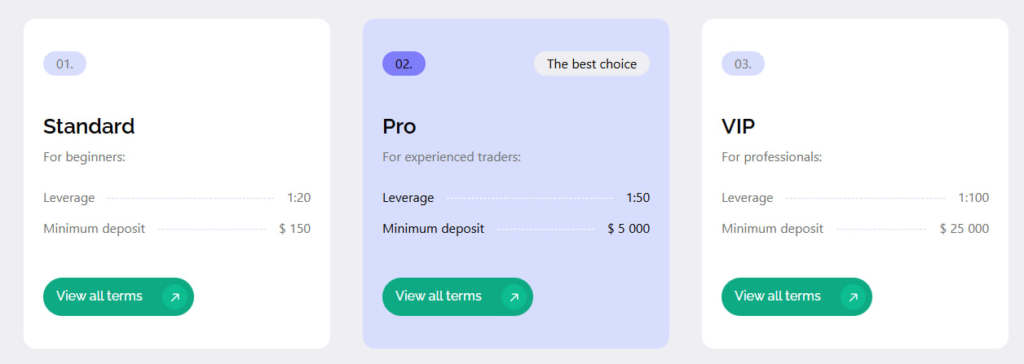
The platform promotes multiple account tiers:
- Standard;
- Pro;
- VIP.
If:
- 100 users deposit the minimum $150,
the platform receives:
$15,000
If:
- 20 users upgrade to VIP packages with $25,000 deposits,
the inflow theoretically reaches:
$500,000
This explains why such platforms often:
- aggressively push deposit upgrades;
- use “analysts”;
- create artificial profitability;
- and obstruct withdrawals.
Even a relatively small number of victims can generate very large financial flows.
Complaints about Isladova.com are already spreading online
The platform is already discussed on:
Users describe:
- withdrawal issues;
- psychological pressure;
- blocked accounts;
- demands for additional payments;
- aggressive “analysts”;
- and the recurring “13% tax” scenario.
The repetition of this exact withdrawal story is particularly revealing.
Why Isladova.com appears especially dangerous

Projects like this do not rely only on technical deception.
They also use:
- social engineering;
- authority manipulation;
- emotional pressure;
- fear of losing profits;
- and artificial urgency.
Victims often believe for weeks or months that:
- they are genuinely trading;
- they are making profits;
- and they are interacting with a real brokerage.
In reality, they may simply be interacting with a controlled internal system.
Isladova.com scam or legitimate?
From a legal perspective, only courts and regulators can issue final determinations.
However, the observable facts are highly concerning:
- licensing claims are not verified;
- fake regulator infrastructure appears present;
- mirror domains exist;
- complaints continue growing;
- the “13% tax” pattern repeatedly appears;
- clone-network characteristics are visible;
- and multiple indicators resemble simulated trading operations.
For financial risk analysts, this combination already places the project into an extremely high-risk category.
Final verdict

Isladova.com demonstrates multiple characteristics commonly associated with organized pseudo-broker infrastructure.
Among the most concerning indicators are:
• fake licensing systems designed to imitate regulation
• clone-network architecture
• the use of mirror domains
• recurring withdrawal extortion patterns
• signs of simulated trading activity
• and aggressive psychological pressure tactics targeting users
At the surface level, the platform attempts to present itself as a regulated international broker with professional branding and institutional-style presentation.
But the deeper the investigation goes, the clearer the pattern becomes.
Instead of verified regulation and transparent operations, the project shows the same structural traits repeatedly observed across disposable clone-broker networks operating under different names but using similar infrastructure and narratives.
And this is what makes such schemes especially dangerous.
The most effective broker scams are often not the ones that look obviously fake.
They are the ones carefully designed to look “almost real”—just convincing enough to stop users from asking the questions that matter most.
Lost money with a broker? Find out how to get it back! Contact us at [email protected], leave your name and phone number so we can get back to you. The Watchdog Online team stands guard over your safety — together we will make the Internet better!
Read also: https://watchdog-online.com/reviews/firvora-scam-review-risk-analysis/
https://watchdog-online.com/reviews/smartaitraders-scam-review-legit-or-not/