General Information
| Parameter | Details |
|---|---|
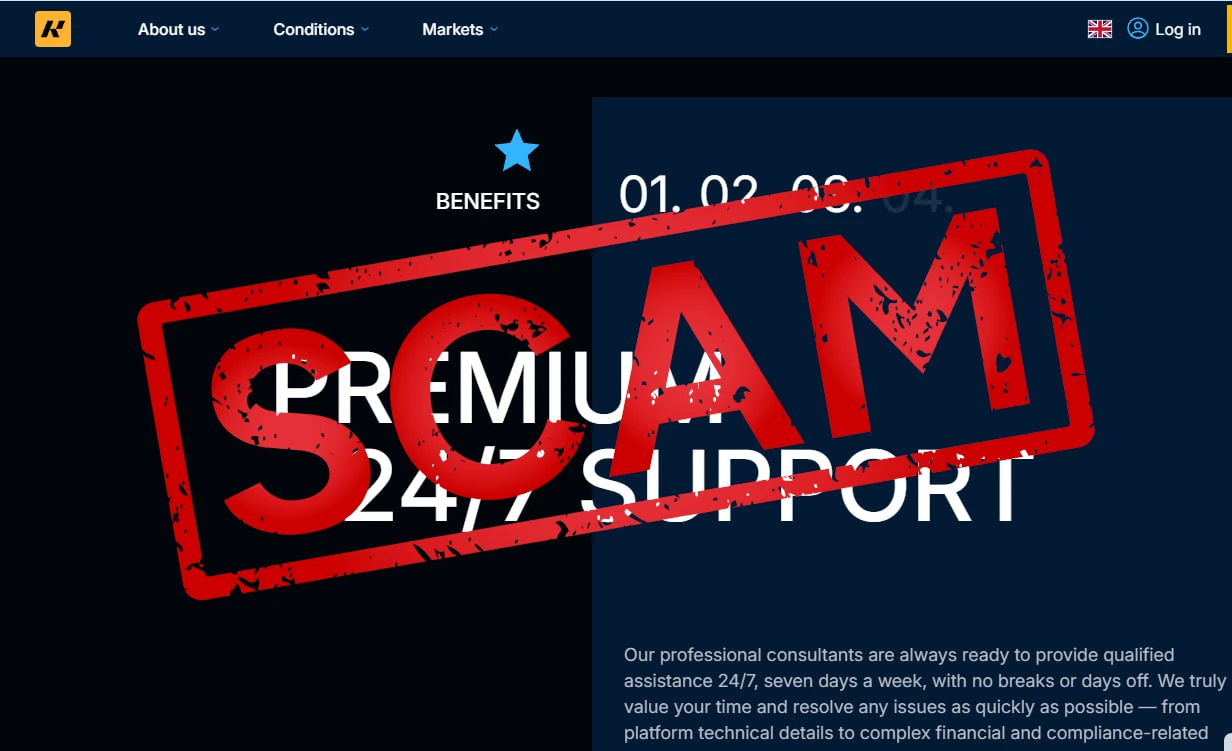
| Project name | Kanbilu |
| Website | https://kanbilu.net |
| Domain registration date | 31 October 2021 |
| Last update | 10 February 2026 |
| Registrar | GoDaddy.com, LLC |
| DNS | Cloudflare |
| Declared address | San Luis 17, Córdoba, Argentina |
| Minimum deposit | 1,000 USD |
| Highest account tier | 50,000 USD |
| Maximum leverage | 1:100 |
| Claimed regulatory basis | Law No. 27,739 – VASP – CNV – UIF |
| Confirmed financial licence | Not found in official registers |
| Risk level | Extremely high |

What Kanbilu claims to be
Kanbilu presents itself as a multi-asset trading platform offering:
- Forex
- Cryptocurrencies
- Stocks
- Indices
- Commodities
- ETF products
- PAMM accounts
- Personal account managers
- Deposit insurance
Account tiers:
Standard – from 1,000 USD
Pro – from 25,000 USD
Vip – from 50,000 USD
Maximum leverage – up to 1:100.
At first glance, this resembles a typical offshore brokerage model. However, the regulatory narrative tells a different story.

The Argentine VASP narrative – a repeated legal template
Kanbilu states that its activity complies with:
- Argentine Law No. 27,739
- VASP status
- CNV supervision
- UIF requirements
Now compare this to:
https://whisperingdawns.net
https://torremyg.net
https://allart.xyz
The legal disclaimer structure is nearly identical.
Not similar in theme.
Identical in construction.
When separate domains use the same regulatory language framework, this does not indicate independent compliance departments. It indicates a shared template.
This is what can reasonably be described as an Argentine VASP-style production model.
CNV verification – the critical fracture point

Kanbilu relies heavily on the claim of VASP compliance.
The official CNV register for Virtual Asset Service Providers:
https://www.cnv.gov.ar/SitioWeb/ProveedoresServiciosActivosVirtuales/RegistrosPSAV
At the time of review, the page displays:
Total registered providers – 0.
If a company holds VASP status, it must appear in the official public register.
No entry is visible.
Without registry confirmation, the claimed status remains unverified.
Regulatory compliance cannot exist only in website text. It must exist in an official register.
VASP vs CFD brokerage – structural contradiction
Kanbilu operates as a leveraged trading platform offering:
- Multi-asset CFD trading
- Leverage up to 1:100
- Tiered capital escalation
- Managed-style services
VASP status applies to virtual asset providers.
CFD brokerage with leverage is a separate regulated activity requiring distinct licensing.
If Kanbilu is a VASP, where is the brokerage licence?
If Kanbilu is a broker, why is VASP the primary regulatory basis?
The regulatory model does not align.
This is not a minor technical oversight. It is a structural inconsistency.
Pseudo-regulators instead of recognised authorities

Kanbilu references:
https://cert-ssf.org/07897337
https://fsa-regulation-uk.net/firm-265974
https://dubai-finance-certify.org/firm-630027
https://vfinsc.org/firm-392178
These entities are not recognised government regulators.
They do not provide:
- Investor compensation schemes
- Ombudsman access
- Enforcement authority
- International supervisory recognition
Compare this to official authorities:
FCA – https://register.fca.org.uk/s/
CySEC – https://www.cysec.gov.cy/en-GB/entities/investment-firms/cypriot/
Kanbilu does not publish a verifiable FCA authorisation number.
No CySEC licence reference is disclosed.
No MiFID passport information is provided.
Certificates are displayed.
Regulatory authority is not.
Leverage and retail standards
In the UK and EU, leverage for retail clients is capped at 1:30 under ESMA and FCA rules.
Kanbilu advertises leverage up to 1:100.
This immediately places the platform outside standard European retail regulatory frameworks.
High leverage combined with aggressive deposit tiers is a classic offshore broker pattern.
Deposit insurance – without insurer disclosure

Kanbilu claims deposit insurance.
However:
- No insurance provider is named
- No policy number is disclosed
- No coverage jurisdiction is specified
- No documentation is provided
In regulated environments, deposit protection is documented, not advertised as a slogan.
Here it functions as a marketing reassurance mechanism rather than a verifiable safeguard.
Behavioural indicators – withdrawal complaints
Critical coverage includes:
https://telltrue.net/eto-lohotron/kanbilu/
https://forexfirst.org/company/kanbilu/
https://scamcheck24.com/kanbilu-review/
https://brokertribunal.com/brokers/kanbilu
https://finoteka.ru/brokers/kanbilu
Common allegations reported:
- Withdrawal delays
- Additional payment demands
- “Tax before release” requests
- Pressure to upgrade accounts
- Escalation of deposit requirements
While review platforms do not serve as regulatory proof, repeated patterns across independent sources indicate behavioural consistency.
Technical footprint and domain signals
Domain registered – 2021
Updated – February 2026
Infrastructure – Cloudflare
The website footer references “2017–2026,” suggesting a longer operational history than the domain itself reflects.
This discrepancy contributes to image-building rather than transparency.
The network pattern

Kanbilu does not exist in isolation.
Whisperingdawns, Torremyg and Allart demonstrate:
- Identical VASP-based regulatory language
- Similar account tier escalation
- Comparable marketing structure
- Matching legal disclaimer frameworks
When the regulatory backbone travels between domains, what remains is not independent corporate identity but repeatable structure.
This is how template-driven brokerage operations function.
Final assessment

Kanbilu does not demonstrate a verifiable financial licence in recognised regulatory registers.
The Argentine VASP narrative is not supported by a visible CNV registry entry.
The brokerage model conflicts with the claimed regulatory basis.
Pseudo-certification sites are used instead of recognised supervisory authorities.
Taken together, this does not resemble a transparently regulated investment firm.
It resembles a structured, template-based brokerage operation using regulatory language as presentation rather than proof.
If regulatory protection cannot be confirmed in an official register, then protection does not exist in enforceable form.
That distinction is critical.
Lost money with a broker? Find out how to get it back! Contact us at [email protected] , leave your name and phone number so we can get back to you. The Watchdog Online team stands guard over your safety — together we will make the Internet better!
Read also: https://watchdog-online.com/article/is-torremyg-a-scam/
https://watchdog-online.com/article/teslaxdealer-com-fake-tesla/