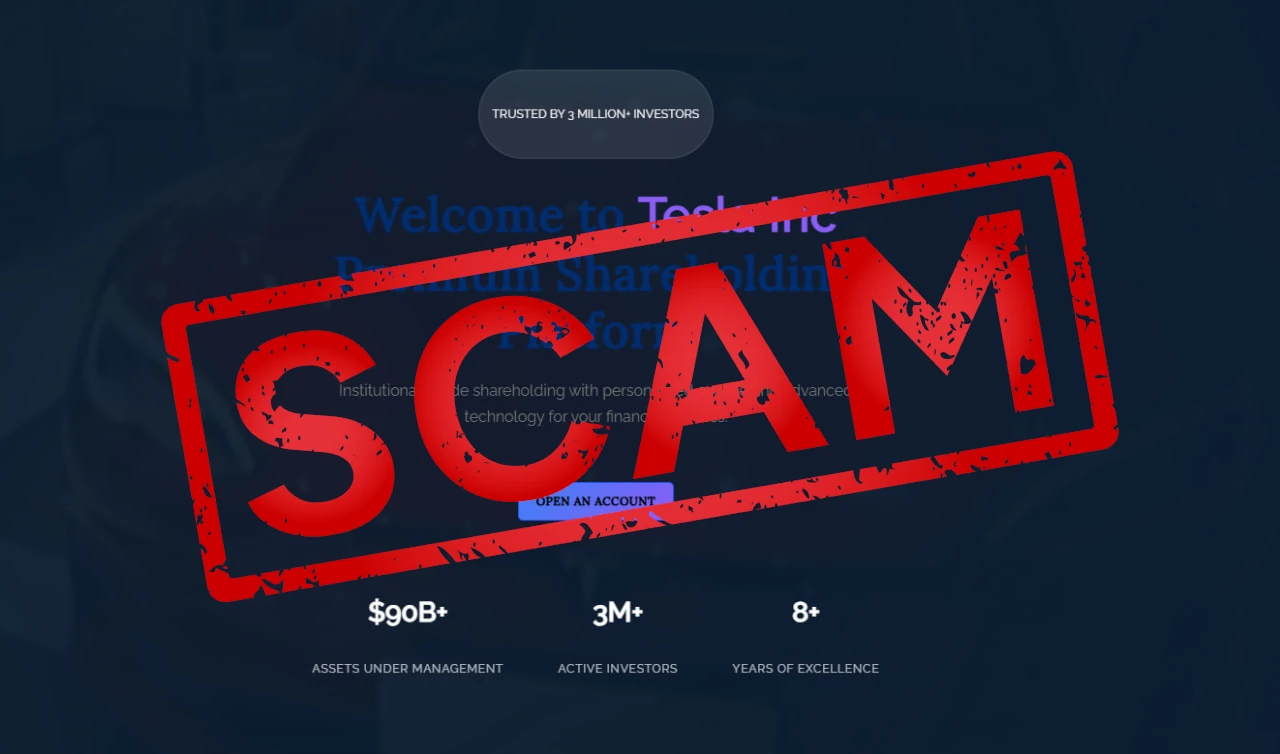
Teslerpro.com tries very hard to make a specific first impression. It does not present itself as just another high-yield website with vague promises. Instead, it wraps itself in the visual and narrative language of Tesla, using phrases such as Tesla Shares LTD, referring to the TSLA ticker, and presenting itself as if it were some kind of specialized gateway into a familiar and respected global brand. That is precisely where the first serious problem begins. When a project cannot build trust on its own legal and regulatory footing, it starts borrowing trust from someone else’s reputation. In the case of Teslerpro.com, that dependence on Tesla-related associations is too obvious to ignore.
But the core problem is not only the branding mimicry. The most important fact is that the Bank of Russia has already added Teslerpro to its warning list with the sign “financial pyramid”, and the entry directly names teslerpro.com. The listing date is 04 March 2026. This is not just online criticism, scattered complaints, or emotional commentary from unhappy users. It is an official regulatory signal that materially changes how the project should be assessed. Once a platform is marked that way by a central bank warning system, it can no longer be treated as some misunderstood “new opportunity.” The risk is already institutionalized. https://cbr.ru/eng/inside/warning-list/detail/?id=43029
The structure becomes even weaker once the technical timeline is examined. According to the WHOIS data shown in the provided screenshot, teslerpro.com was registered only on 10 January 2026, with HOSTINGER operations, UAB listed as registrar. For a project trying to look like a serious investment story built around Tesla-related equity language, that is an extremely weak foundation. A young domain alone does not prove fraud. That should be stated clearly. But when a fresh domain appears together with a central bank warning, aggressive return promises, unclear legal identity, and visible brand mimicry, it stops being a neutral detail and becomes part of a larger high-risk pattern.
And if Teslerpro.com is viewed not through the eyes of a casual visitor, but through the eyes of someone used to checking financial platforms by evidence, the structure looks familiar in the worst possible way. First the user is given a powerful brand association. Then a polished investment narrative. Then ready-made return packages. Only after that does it become clear that none of this rests on the kind of transparent legal and regulatory infrastructure that a real intermediary handling client money would be expected to show. That is exactly why Teslerpro.com deserves not a superficial review, but a full regulatory and structural assessment.
General information about Teslerpro
| Parameter | Details |
|---|---|
| Project name | Teslerpro / Tesla Shares LTD |
| Website | https://teslerpro.com |
| Domain | teslerpro.com |
| Domain registration date | 2026-01-10 |
| Registrar | HOSTINGER operations, UAB |
| Listed addresses | 1 Tesla Road, Austin, Texas 78725, USA; 1501 Page Mill Road, Palo Alto, California 94304, USA; Tesla Straße 1, 15537 Grünheide, Brandenburg, Germany |
| Listed email | [email protected] |
| Minimum entry amount | from USD 100 based on public package materials |
| Claimed return | 2.5% to 150% weekly depending on the package |
| Referral bonus | 5%, and 50% in the promo package |
| Claimed license | not confirmed |
| FCA verification result | not confirmed |
| CySEC verification result | not confirmed |
| Bank of Russia status | warning list, sign “financial pyramid” |
| Risk classification | Very high |
Why Teslerpro already fails a basic transparency test
A normal financial intermediary starts by showing its legal backbone. The user sees the corporate entity, the regulator, the license, the jurisdiction, and the rules of accountability. Here the logic is reversed. First the user is shown Tesla, TSLA, “shares,” investments, and returns. The legal basis stays vague. The footer lists addresses in Austin, Palo Alto, and Grünheide, but there is no clear demonstration of which exact entity stands behind the platform and under what regulatory regime it operates. That kind of geography without a clear corporate structure does not look like scale. It looks like assembled credibility.
That is especially important because Tesla’s own investor-facing materials do in fact use the address 1 Tesla Road, Austin, TX 78725, and Tesla stock really does trade on NASDAQ under TSLA. In other words, the real-world references used by Teslerpro are not fictional. They are real reference points attached to a real public company. That is exactly what makes the imitation more serious, not less. A regulated intermediary can refer to public companies because it has its own regulatory footing. Teslerpro appears to use those references without showing equivalent transparency. https://ir.tesla.com/contact-us https://ir.tesla.com/node/16 https://www.nasdaq.com/market-activity/stocks/tsla
Does Teslerpro have a license
If a project is genuinely involved in investment activity and client money, its status should be checked through official registers. For the UK, that means the FCA Register at https://register.fca.org.uk/ For the EU, one clear example is the CySEC register at https://www.cysec.gov.cy/en-GB/entities/investment-firms/cypriot/
The review of official regulatory registers does not confirm the existence of any license.
That sentence is one of the key points in the entire article. Teslerpro does not present a clear and verifiable connection between its domain, brand, operator, and any confirmed regulated status. It shows products and return promises, but not the thing a real financial intermediary must show first: a verifiable legal entity and a verifiable license. Against the background of a Bank of Russia warning entry, that is not a minor omission. It is a central compliance failure. https://register.fca.org.uk/ https://www.cysec.gov.cy/en-GB/entities/investment-firms/cypriot/ https://cbr.ru/eng/inside/warning-list/detail/?id=43029
How the Teslerpro model actually works
Once the package structure is examined, the picture becomes much more direct. The site publicly shows packages with weekly returns of 2.5%, 3.5%, 4.5%, 5.5%, 9%, and in the promo package even 150% weekly. The ordinary packages are shown with an “8 months” duration, while the promo package is shown with a “1 week” term. This is not how a broker presents market access. This is how a yield-driven scheme presents a product.
That distinction matters. A broker does not sell fixed package returns. A broker gives access to the market, and outcomes depend on price movement, execution, commissions, and market risk. Teslerpro does the opposite. It sells the expectation of an outcome. And that outcome is aggressive even by the standards of already suspicious investment websites. When a site combines “Tesla shares,” fixed weekly profit, and a purchase button, the result no longer looks like a normal investment service. It looks like a marketing shell built around deposit attraction.
The mathematics make the problem even more obvious. If a user places USD 100,000 into a package promising 9% weekly, the expected payout is USD 9,000 per week. If the promo package promising 150% weekly is taken at face value, the promise leaves normal market logic entirely. To sustain obligations of that size, the operator would need either an exceptional, documented, and stable external revenue engine, or a steady stream of new incoming money. Once a referral bonus is layered on top, the second explanation becomes much more plausible. That is the point at which the investment story starts to resemble a pyramid-type funding structure.
Is Teslerpro legit or a scam
If the colors, styling, and Tesla references are stripped away, the risk indicators are difficult to ignore. There is an official Bank of Russia warning list entry with the sign “financial pyramid,” a very young domain, returns of up to 150% per week, referral bonuses, broad geographic storytelling, and no confirmed regulated status. For a cautious reader, the question “is Teslerpro legit or a scam” stops being abstract. There is simply too little verifiable foundation and too many classic signals of a toxic structure. https://cbr.ru/eng/inside/warning-list/detail/?id=43029
A careful conclusion follows naturally from that. Teslerpro does not look like a transparent and verifiable financial intermediary. It looks like a high-risk model in which borrowed brand trust, packaged returns, and prestige geography are used as decorative tools to attract deposits.
Teslerpro and the historical Tesler brand pattern
Teslerpro does not look like an isolated new invention. It looks more like another version of a broader line of projects using the Tesler name and combining it with trading, investment, or automated earning narratives. That matters not only reputationally, but also from a compliance perspective. Regulators have previously issued warnings connected with closely related branding, including Tesler, Tesler Trading Systems, Tesler/7Tesler, and tesler.today. In some cases such projects were described as clones. In others they were subject to investor alerts and warning publications. https://www.fca.org.uk/news/warnings/tesler-teslertoday-clone-fca-authorised-firm https://www.securities-administrators.ca/investor-alerts/tesler/
This does not automatically mean that every domain containing the word Tesler is operated by the same group. But a careful anti-scam analysis does not require that level of certainty. The repeated regulatory trail alone shows that the combination Tesler + trading/investment has long occupied a toxic high-risk zone. Against that background, teslerpro.com does not look like a genuinely new opportunity. It looks like another iteration of a familiar pattern in which the web address changes but the core signs remain: aggressive returns, marketing mimicry, unclear legal status, and an attempt to borrow trust from a larger name.
That is why Teslerpro should not be evaluated in isolation. When a new domain appears with the same branded root, an investment story, and quickly receives a financial pyramid sign in a central bank warning list, that no longer looks like coincidence. It looks like repeat behavior. https://cbr.ru/eng/inside/warning-list/detail/?id=43029
Geography and Tesla mimicry
The footer is especially revealing. It presents addresses in Austin, Palo Alto, and Grünheide, places strongly associated with Tesla’s real-world corporate presence. The effect is deliberate: the user is meant to feel close to the infrastructure of a real public company. But association is not proof of connection. In a normal investment jurisdiction, that kind of presentation without a confirmed legal and regulatory link looks deeply problematic.
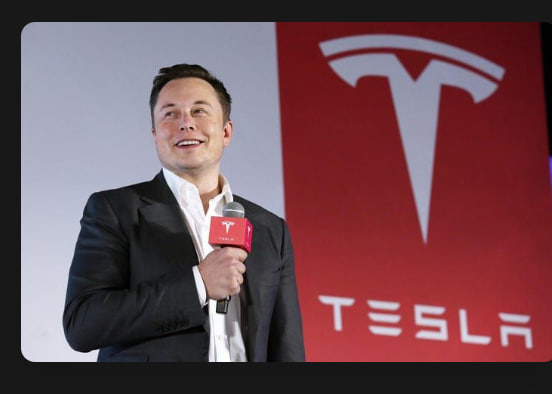
This is where the mimicry becomes especially clear. The site does not merely use the name Tesla Shares LTD. It places the user inside the real Tesla context: the brand, the visual cues, the Tesla stock theme, and the TSLA ticker. That is not an accidental reference. It is a trust architecture. First comes the familiar symbol, then the promised return, then the purchase action. From an anti-scam perspective, this is one of the strongest argumentative blocks in the case: Teslerpro does not build trust on its own transparency. It tries to borrow trust from someone else’s brand. https://ir.tesla.com/contact-us https://ir.tesla.com/node/16
What is being said about Teslerpro: reviews and complaints

Searches such as “teslerpro.com reviews,” “Teslerpro review,” and “teslerpro.com scam” already have a negative background around them. The complaint page and Instagram post you provided can be used as an additional layer. Working direct links are https://moshennik.eu/company.php?name=teslerpro and https://www.instagram.com/p/DVgiBxDDDKU/ But the important thing is not to confuse noise with foundation. The foundation here is not third-party commentary. It is the official Bank of Russia warning list entry, the extreme return structure, the young domain, and the Tesla-related brand mimicry.
That is why complaints and reviews should be treated as supplementary material. They strengthen the picture, but they do not replace verifiable facts. In this case, the verifiable facts are already substantial: the regulator has already raised a red flag, and the site itself has presented a model that strongly resembles classic pyramid-type mechanics. The moshennik.eu page directly ties Teslerpro to the Bank of Russia warning information, while the Instagram material frames the case as a forensic review of an aggressive investment structure. That is not an official verdict, but it is a relevant complaints layer. https://moshennik.eu/company.php?name=teslerpro https://www.instagram.com/p/DVgiBxDDDKU/
Risk indicators around Teslerpro
| Risk Indicator | Present |
|---|---|
| Bank of Russia warning list presence | Yes |
| “Financial pyramid” sign from the Bank of Russia | Yes |
| Very young domain | Yes |
| Unconfirmed license | Yes |
| Use of Tesla branding in marketing | Yes |
| Use of TSLA ticker association | Yes |
| Multiple addresses in different countries | Yes |
| Fixed weekly returns | Yes |
| Returns of up to 150% per week | Yes |
| Referral bonus | Yes |
| Promo package with 50% referral bonus | Yes |
| Transparent regulated legal entity | No |
| Confirmed connection to Tesla | No |
How a regulated intermediary differs from Teslerpro
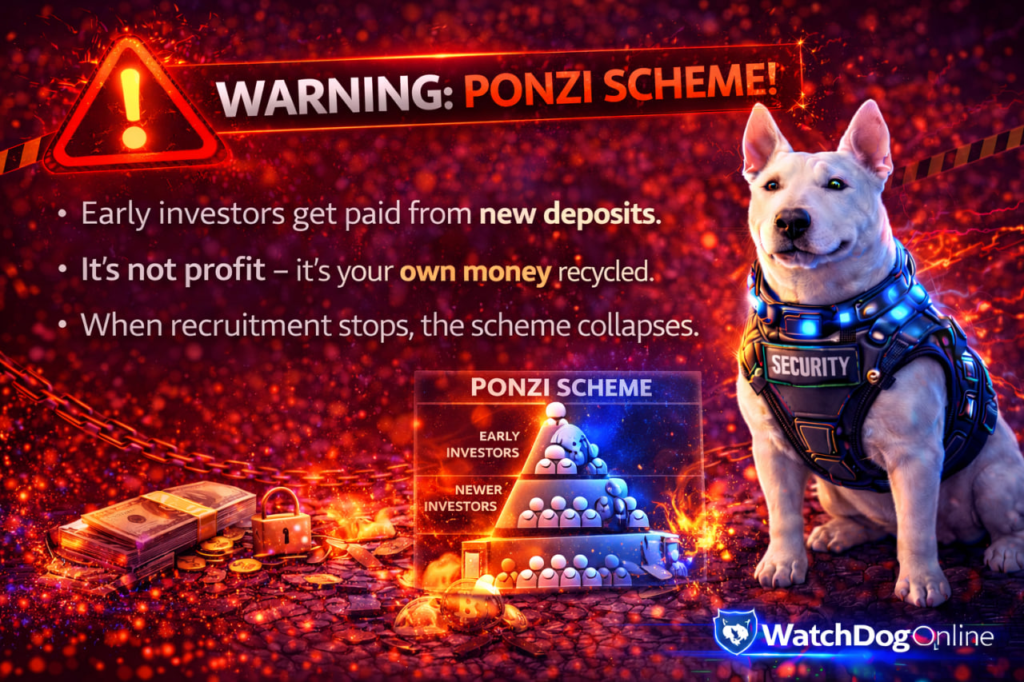
A regulated intermediary begins by disclosing the legal basis of its activity. It shows the firm, the license, the regulator, the service conditions, the risk disclosures, the custody model, and the complaint framework. If the topic is buying shares in a public company, the user receives ordinary broker infrastructure, not pre-packaged percentages on “share packages.” Real Tesla shares do exist as securities of a public company traded on NASDAQ under TSLA, but access to them is provided through a normal broker channel, not through websites promising fixed weekly returns. https://ir.tesla.com/node/16 https://www.nasdaq.com/market-activity/stocks/tsla
Teslerpro reverses that order completely. First comes Tesla, TSLA, “buy shares,” percentages, bonuses, and glossy packages. Then comes a scattering of addresses and a contact email. Only after that, once checking begins, does the Bank of Russia warning list appear together with the absence of any confirmed regulated status. That is exactly what the institutional contrast looks like: a real intermediary builds trust from accountability toward product, while projects like this move from a polished story toward a trusting deposit.
FAQ about Teslerpro
Does Teslerpro have a license?
No confirmed and verifiable license is shown on the site, and official registers do not confirm a regulated status for the project. https://register.fca.org.uk/ https://www.cysec.gov.cy/en-GB/entities/investment-firms/cypriot/
Why does Teslerpro raise suspicion?
Because it combines a Bank of Russia warning entry, a young domain, returns of up to 150% per week, referral bonuses, and visible mimicry of Tesla.
Is Teslerpro connected to the real Tesla?
No confirmed connection to the real Tesla appears in verifiable official data. The site uses brand associations, the TSLA ticker, and Tesla-related geography, but that is not the same thing as corporate affiliation. https://ir.tesla.com/node/16
Why do people search for “teslerpro.com scam”?
Because the site combines extreme returns, recruitment bonuses, brand mimicry, and the absence of confirmed regulated status, which is exactly the kind of combination that triggers reliability questions.
Final conclusion
In the end, Teslerpro.com does not look like a transparent investment platform or an intermediary that can be trusted with money without serious reservation. It is a project with a very young domain, an official Bank of Russia warning for signs of a financial pyramid, aggressive return packages, referral mechanics, and a visible attempt to insert itself into trust surrounding the real Tesla through branding, geography, and the TSLA ticker. Some of these signs could perhaps be debated in isolation. Together, they form a far too coherent and familiar pattern.
What matters most is that Teslerpro.com does not build trust the way real financial intermediaries do: not through a verifiable license, not through a clear legal entity, not through a transparent operating model, and not through a visible client-protection framework. Instead, the user is offered something else: a strong name, polished promises, ready-made percentages, and the feeling of stepping into a story connected with a famous public company. That is exactly how many dangerous schemes work. First they offer a recognizable and emotionally powerful image, and only then do they ask the user to believe in returns that look abnormal in normal investment logic.
That is why the risk here should not be described as abstract or mildly elevated. It is very high and structural. When a project promises 2.5% to 150% per week, fails to show a confirmed regulated status, and has already appeared on the Bank of Russia warning list, the user enters a zone where meaningful client protection is barely visible. In that kind of situation, the decisive point is not how polished the site looks. It is how weak the verifiable reality behind it appears.
Teslerpro.com does not look like a new investment opportunity. It looks like a project critically lacking transparency, confirmed legitimacy, and normal financial logic. A powerful чужой brand cannot replace a license, transparency, or a real source of money.
Lost money with a broker? Find out how to get it back! Contact us at [email protected] , leave your name and phone number so we can get back to you. The Watchdog Online team stands guard over your safety — together we will make the Internet better!
Read also: https://watchdog-online.com/article/mentoris-mentoris-life-scam/