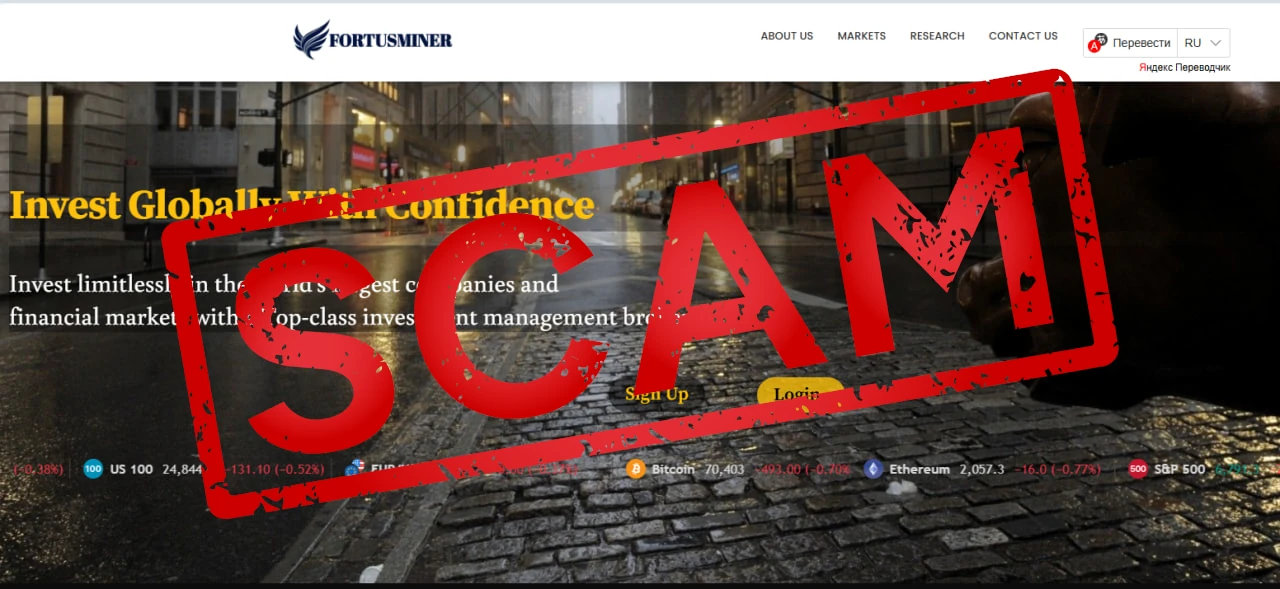
Fortusminer presents itself as a global broker with references to FCA, SEC, FINRA, MT4, crypto, stocks, ETFs, and investment services. For a UK or EU retail audience, that branding is designed to signal institutional credibility. The problem is that the public profile does not support the image. The domain is very new, the website promotes fixed-return investment packages, and the legal identity behind the project is not transparently established in a way that would satisfy even basic UK or EU due diligence.
The most important external red flag is official. The Bank of Russia has listed Fortusminer in its warning database and marks it with signs of an illegal professional securities market participant, with fortusminer.com named in the entry and the date shown as 03 March 2026. For any investor asking whether Fortusminer is a legitimate regulated intermediary, that warning changes the risk assessment from speculative concern to formal regulatory exposure. Direct source: https://cbr.ru/eng/inside/warning-list/detail/?id=42967
The second major issue is structural. This is not just a site with vague promises. The public materials show fixed-return package logic such as 10% in 12 hours, 15% in 3 days, and 40% daily for 5 days, alongside referral rewards. That is not how a normal regulated UK or EU broker presents its business model. A regulated broker provides market access and charges commissions, spreads, or service fees. It does not package extreme short-term returns as if they were standard financial products. This is one of the clearest reasons Fortusminer raises immediate compliance concerns. That gap between broker language and payout mechanics is central to the whole case.
| Parameter | Details |
|---|---|
| Project name | Fortusminer |
| Website | https://fortusminer.com |
| Domain registration date | 2026-01-17 |
| Registrar | HOSTINGER operations, UAB |
| Claimed jurisdiction | UK implied through Edinburgh address and FCA language |
| Claimed legal entity | not clearly confirmed |
| Minimum deposit | from $50 on public package materials |
| Maximum leverage | not clearly disclosed |
| Claimed regulation | FCA references, plus SEC and FINRA mentions |
| FCA verification result | not confirmed |
| EU verification result | not confirmed |
| Warning list status | Bank of Russia warning entry |
| Risk classification | High |

Why Fortusminer fails the UK authorization test
In the UK, investment services require authorization, and the official verification point is the FCA Register. Direct source: https://register.fca.org.uk/ The review of official regulatory registers does not confirm the existence of any license. That matters because Fortusminer does not present a verified domain-to-license connection, a confirmed FCA-authorized operating entity, or the normal disclosure package that a regulated UK firm would provide. The website’s self-description is not enough. In UK compliance terms, regulated status must be verifiable through official records, not inferred from marketing language.
The UK framework is also specific about retail protection. The FCA’s permanent restrictions on CFDs for retail consumers include leverage limits ranging from 30:1 to 2:1, margin close-out protection, negative balance protection, and a ban on inducements designed to encourage trading. Alongside that, the Financial Services Compensation Scheme explains that eligible investment claims may be protected within scope when a regulated firm fails. Direct sources: https://www.fca.org.uk/news/press-releases/fca-confirms-permanent-restrictions-sale-cfds-and-cfd-options-retail-consumers and https://www.fscs.org.uk/what-we-cover/investments/ Fortusminer does not present a confirmed authorization basis for those protections, nor does it show the disclosure quality expected from a real UK-regulated intermediary.
The Companies House mismatch is a serious compliance problem
One of the most important issues in this case is identity borrowing. Public records show that company number SC209311 belongs to PRINCES EXCHANGE (NOMINEES) LIMITED, an active UK private limited company, with a registered office at Princes Exchange, 1 Earl Grey Street, Edinburgh, EH3 9EE. That is a real company and a real address. But that does not make Fortusminer the same entity, and it does not confer regulated status on fortusminer.com. Direct source: https://find-and-update.company-information.service.gov.uk/company/SC209311
This distinction matters. If a website uses a real UK company number and a real Edinburgh address to support its own broker narrative without establishing a verified legal and regulatory link, that is not a minor documentation issue. It is a credibility problem at the core of the compliance analysis. UK investors should treat this as a material red flag, because institutional legitimacy cannot be borrowed from an unrelated Companies House record. Public Companies House records also show ongoing officers and office use linked to that entity, reinforcing that SC209311 belongs to a separate real company rather than to Fortusminer. Direct sources: https://find-and-update.company-information.service.gov.uk/company/SC209311 and https://find-and-update.company-information.service.gov.uk/company/SC209311/officers
The EU position is no better

For EU-facing activity, the baseline is MiFID-style authorization, investor-protection controls, and ongoing supervision through an official regulator. CySEC’s public register exists so users can verify whether a firm is licensed, and CySEC also provides formal complaint routes for Cyprus Investment Firms and separate reporting routes for non-regulated entities. Fortusminer does not present a confirmed EU investment license, a confirmed Cypriot investment firm identity, or any verified passporting basis for cross-border financial services. That leaves the platform outside the normal EU verification framework. Direct sources: https://www.cysec.gov.cy/en-GB/entities/investment-firms/cypriot/ and https://www.cysec.gov.cy/en-GB/investor-protection/how-to-complain/ and https://www.cysec.gov.cy/en-GB/investor-protection/non-regulated/
The broader EU risk context also matters. ESMA’s CFD intervention measures imposed retail leverage restrictions from 30:1 down to 2:1 because regulators considered uncontrolled retail exposure a serious investor-protection issue. Against that backdrop, a project promoting extreme fixed-return packages and referral rewards without confirmed supervision stands far outside normal EU retail-finance standards. Direct source: https://www.esma.europa.eu/press-news/esma-news/esma-renew-restrictions-cfds-further-three-months-1-may-2019
Fortusminer review – how the model creates structural risk

The key issue is not the branding alone. The key issue is economic substance. Fortusminer publicly combines broker language with package-based promises such as 10% in 12 hours, 15% in 3 days, and 40% daily for 5 days. That means users are not simply being offered a trading interface. They are being sold an expectation of extreme pre-packaged returns. In regulated markets, that is a completely different risk profile from a broker execution service.
A simple calculation shows the pressure. Assume a user places $10,000 into a package marketed at 40% daily for 5 days. Even without taking the most aggressive compounding interpretation, the implied payout pressure becomes extreme in just a few days. Now scale that across multiple users. To fund such obligations through legitimate external business activity, the operator would need an exceptional and transparently documented revenue engine. Nothing in the publicly verifiable profile shows that kind of economic base.
That is why the structure looks deposit-dependent. If promised returns are far above regulated market norms and no credible source of sustainable external income is disclosed, then obligations are likely to depend on ongoing inflows, not on transparent market activity. In professional compliance terms, this is the pattern of a high-risk unregulated redistribution model: large promises, weak disclosure, and strong dependence on fresh money. The referral component makes that pressure worse by incentivizing expansion of the participant base rather than demonstrating genuine investment capacity.
Our analysts note that this is exactly why extreme fixed-return structures attract regulatory suspicion. The model does not behave like a conventional broker. It behaves like a system that needs continual inflow support to preserve credibility.
Is Fortusminer legit or a scam?
From a strict legal-writing perspective, unsupported criminal labels should be avoided. But from a compliance and risk-analysis perspective, the profile is plainly adverse. There is an official central-bank warning, no confirmed FCA authorization, no confirmed EU investment license, no verified regulated operator identity, and a business narrative built around extreme fixed returns and referral incentives. That is why search queries such as “is Fortusminer legit” or “Fortusminer scam” naturally arise.
The key point is not rhetoric. It is verification. Users asking whether Fortusminer is legitimate are really asking whether the entity can prove regulated status, legal responsibility, and investor-protection coverage. On the currently available public record, those confirmations are not there. The regulatory burden is not on the user to imagine a compliant explanation. It is on the operator to prove one. Fortusminer does not do that on the public record as it stands. Direct source: https://cbr.ru/eng/inside/warning-list/detail/?id=42967
Jurisdiction and accountability gaps around Fortusminer
Fortusminer also performs poorly on basic accountability signals. The public-facing profile relies on a UK address narrative and on borrowed-seeming corporate identifiers, but it does not establish a clearly verified operating entity that a retail user can connect to a regulatory perimeter. That matters for both UK and EU audiences because investor protection depends on knowing who the actual counterparty is, which authority supervises it, and where complaints can go.
CySEC’s complaint guidance for Cyprus Investment Firms, and its separate route for non-regulated entities, illustrate the point well. Formal complaint systems only function within a properly identified regulatory structure. If no confirmed regulated entity is identified in the first place, those protections are out of reach. Direct sources: https://www.cysec.gov.cy/en-GB/investor-protection/how-to-complain/ and https://www.cysec.gov.cy/en-GB/investor-protection/non-regulated/
Fortusminer complaints, reviews, and search intent
Search users do not usually start with a legal memo. They start with queries like “Fortusminer review,” “Fortusminer complaints,” “is Fortusminer legit,” or “Fortusminer FCA.” Those queries matter because they reflect a real due-diligence pattern: users sense that the branding is overbuilt and the verification trail is underbuilt.
That is why the review layer should be treated carefully. Anonymous review noise should never replace official records. But when users repeatedly search for warnings, legitimacy, and complaints, and the official record already includes a central-bank warning plus a company-number mismatch issue, that search behavior is not random. It is consistent with a platform whose public claims do not survive straightforward regulatory checking. In professional compliance terms, this is a high-risk unregulated model rather than a transparently supervised investment intermediary. Direct source: https://cbr.ru/eng/inside/warning-list/detail/?id=42967
Risk indicators around Fortusminer
| Risk Indicator | Present |
|---|---|
| No confirmed FCA authorization | Yes |
| No confirmed EU license | Yes |
| Official warning list presence | Yes |
| Signs of illegal securities-market activity flagged by a central bank | Yes |
| Very new domain | Yes |
| Fixed extreme returns | Yes |
| Referral rewards | Yes |
| No confirmed compensation scheme | Yes |
| No confirmed domain-to-license relationship | Yes |
| UK company-number mismatch risk | Yes |
| No clearly verified regulated operator | Yes |
| High retail-investor risk profile | Yes |

How a regulated UK/EU intermediary operates versus how Fortusminer operates
A regulated UK or EU intermediary begins with identity, authorization, supervision, and investor protections. Users can verify the firm through an official register, understand which legal entity is responsible, see what compensation or complaint framework exists, and assess the product under a known regulatory perimeter. That is the normal order: responsibility first, marketing second. Direct sources: https://register.fca.org.uk/ and https://www.cysec.gov.cy/en-GB/entities/investment-firms/cypriot/ and https://www.fscs.org.uk/what-we-cover/investments/
Fortusminer presents the reverse order. The sales narrative comes first: broker language, global-market branding, and aggressive return packages. Only after scrutiny do the core weaknesses become obvious: no confirmed authorization, no transparent operator identity, a serious Companies House mismatch issue, a very new domain, and an official warning-list entry. That is not how a regulated retail-facing financial model normally looks.
FAQ about Fortusminer
Is Fortusminer regulated in the UK?
No confirmed FCA authorization is established on the public record, and the official place where such authorization would need to be verified is https://register.fca.org.uk/
Does Fortusminer have an EU investment license?
The publicly available profile does not show a confirmed EU investment license or a verified EU-regulated investment firm identity. The relevant verification route is https://www.cysec.gov.cy/en-GB/entities/investment-firms/cypriot/
Is Fortusminer on a warning list?
Yes. The Bank of Russia lists Fortusminer with signs of an illegal professional securities market participant. Direct source: https://cbr.ru/eng/inside/warning-list/detail/?id=42967
Why is Fortusminer considered high risk?
Because the public record combines a very new domain, extreme fixed-return packages, referral rewards, no confirmed FCA or EU authorization, and a serious mismatch between the site narrative and the Companies House record for SC209311.
Final conclusion
Fortusminer cannot be treated as a verified regulated financial entity for UK or EU investors. The public record does not confirm FCA authorization, does not confirm an EU investment license, does not establish a clearly verified regulated operator, and does not support the investor-protection expectations attached to legitimate UK/EU financial intermediaries. At the same time, the project is on an official warning list and promotes a return structure that is incompatible with normal regulated broker conduct. Direct source: https://cbr.ru/eng/inside/warning-list/detail/?id=42967
For retail investors, the risk is high and structural. Our experts recommend avoiding any financial interaction with this project.

If regulation cannot be verified, the risk is not speculative – it is structural.
Lost money with a broker? Find out how to get it back! Contact us at [email protected] , leave your name and phone number so we can get back to you. The Watchdog Online team stands guard over your safety — together we will make the Internet better!
Read also: https://watchdog-online.com/article/sowilli-net-scam/
https://watchdog-online.com/article/is-axora-capital-cue-scam/