Introduction
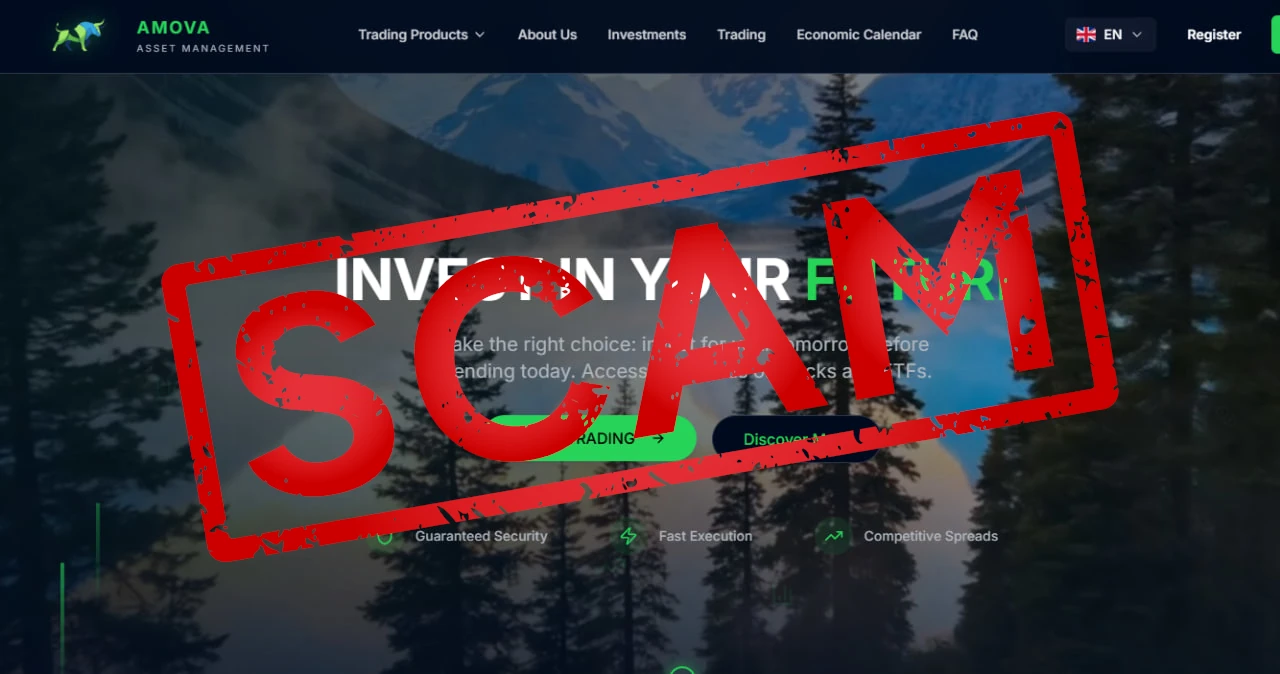
Amova Assets (amova-assets.com) presents itself as a European investment firm allegedly operating under the supervision of the Central Bank of Ireland and aligned with MiFID II requirements. The website references a Dublin commercial address, regulatory identifiers, and offers access to forex, equities, indices, ETFs and digital assets. The presentation is structured to convey institutional credibility.
However, regulatory credibility is not established by branding or jurisdictional references. It is established through verifiable authorization tied to a defined legal entity and a regulator-recognized domain presence. The domain amova-assets.com was registered in January 2026, resulting in a limited operational footprint for a firm claiming regulated European status.
In addition, the branding closely mirrors the established global asset management group Amova Asset Management, which operates under a separate and long-standing corporate domain structure. When a recently created trading domain adopts near-identical institutional branding, the exposure shifts beyond regulatory verification into potential brand impersonation risk.
Our analysts note that institutional investment firms operate within clearly defined supervisory perimeters. Where authorization cannot be independently verified, structural compliance risk must be assumed.
General Information Table
| Parameter | Details |
|---|---|
| Project name | Amova Assets |
| Website | https://amova-assets.com |
| Domain registration date | 12 January 2026 |
| Registrar | Namecheap |
| Claimed jurisdiction | Ireland |
| Minimum deposit | Not transparently disclosed |
| Maximum leverage | Not publicly specified |
| Claimed regulation | Central Bank of Ireland, CONSOB, MiFID II |
| FCA verification result | No confirmed authorization via https://register.fca.org.uk/ |
| EU verification result | No confirmed listing via https://www.cysec.gov.cy/ |
| Warning list status | Not listed on Bank of Russia warning list at time of review |
| Risk classification | High |

UK Regulatory Compliance – FCA Authorization Requirement
Investment services offered to UK retail investors require authorization by the Financial Conduct Authority. The FCA register remains the sole official verification source:
https://register.fca.org.uk/
The review of official regulatory registers does not confirm the existence of any license.
Authorization must be linked to:
- A specific legal entity
- A defined scope of regulated activities
- A registered and disclosed domain
- Prudential capital reporting
- Ongoing supervisory monitoring
Under the UK Investment Firms Prudential Regime (IFPR), firms must maintain own-funds thresholds proportionate to operational and market exposure. Retail CFD providers are subject to leverage caps, standardized risk disclosures, negative balance protection, and CASS client money segregation requirements.
Crucially, FCA enforcement powers include supervisory inspections, capital adequacy reviews, public warning notices, and financial penalties. If a platform operates outside this supervisory perimeter, UK retail investors cannot rely on FSCS compensation eligibility or enforceable dispute resolution mechanisms.
Authorization is entity-specific. Brand similarity does not transfer regulatory status.

EU Regulatory Framework – MiFID II and Passporting Mechanics
Within the European Union, investment firms must be authorized under MiFID II by a national competent authority. CySEC serves as one example of such authority:
https://www.cysec.gov.cy/
Authorization requires:
- Defined initial capital thresholds
- Ongoing own-funds compliance
- Client asset segregation
- Governance and risk management controls
- Participation in Investor Compensation Fund mechanisms
- Periodic supervisory reporting
Passporting rights allow a licensed firm to provide services cross-border within the EU. However, passporting requires formal notification between competent authorities and recognition within supervisory databases.
If a firm claims Irish authorization yet offers services broadly without verifiable passporting confirmation, supervisory perimeter integrity cannot be assumed.
In this review, no publicly verifiable linkage between amova-assets.com and an authorized EU investment firm has been identified.

Mathematical and Structural Risk Analysis
Two structural liquidity models illustrate exposure.
Scenario 1 – Retail Drawdown Redistribution Model
Assume:
180 retail clients deposit €3,000 each
Total deposits = €540,000
If average retail drawdown equals 25%:
Loss pool = €135,000
In a segregated regulatory framework, such losses remain client-side trading outcomes. In a non-segregated internalization model, this amount can function as operational liquidity.
This creates a redistribution dynamic where client losses support platform sustainability.
Scenario 2 – Liquidity Stress and Coverage Ratio
Assume 80 clients request full withdrawal:
80 × €3,000 = €240,000
If liquid reserve equals €140,000:
Shortfall = €100,000
Coverage ratio = 0.58
A coverage ratio below 1.0 signals deposit-dependent structural vulnerability.
If new deposit inflow declines by 30%, liquidity stress accelerates. Collapse triggers typically include withdrawal processing delays, revised internal compliance checks, and revised trading condition policies.
Our analysts note that such deposit-dependent structures rely on continuous capital inflow. When inflow slows, liquidity imbalance becomes systemic.
In regulated firms, capital buffers and supervisory reporting mitigate this exposure. Without oversight, liquidity transparency remains unverifiable.

Address, Jurisdiction and Domain Infrastructure
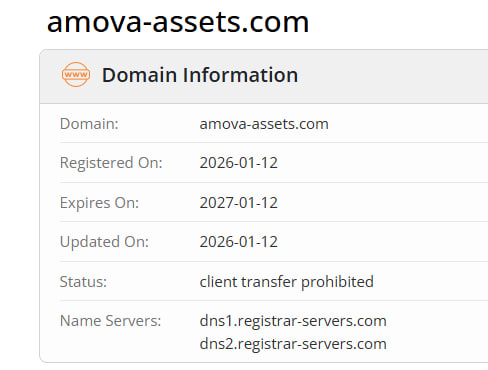
The website lists 33 Sir John Rogerson’s Quay, Dublin — a legitimate commercial address hosting multiple companies.
WHOIS analysis indicates:
- Domain created January 2026
- One-year registration term
- Registrar: Namecheap
- Standard registrar-based DNS infrastructure
Institutional asset managers typically maintain long-duration domain registrations, corporate registrar protections, and documented archival continuity.
The established Amova Asset Management entity operates under amova-am.com with consistent corporate domain structure and long-standing operational history.
amova-assets.com demonstrates:
- Brand-adjacent naming variation
- Recently established domain
- Domain-email inconsistency
- No verifiable regulator-domain linkage
In professional compliance terminology, this configuration aligns with a high-risk unregulated operating model combined with brand adjacency exposure.
Risk Indicators Table
| Risk Indicator | Present |
|---|---|
| No FCA authorization | Yes |
| No EU license confirmation | Yes |
| Brand adjacency to established firm | Yes |
| New domain registration | Yes |
| One-year registration cycle | Yes |
| No confirmed compensation scheme | Yes |
| No verified capital adequacy disclosure | Yes |
| No confirmed segregated fund confirmation | Yes |
Institutional Contrast

A regulated UK or EU investment firm operates under enforceable oversight.
Regulated entity characteristics:
- Listed in official regulatory registers
- Maintains prudential capital buffers
- Segregates client funds under statutory frameworks
- Participates in compensation schemes
- Files regulatory financial reports
- Subject to supervisory audits
- Exposed to enforcement and sanction mechanisms
- Provides formal complaint escalation channels
By contrast, Amova Assets (amova-assets.com):
- Does not demonstrate confirmed FCA authorization
- Does not show verifiable EU licensing
- Operates under a recently created domain
- Provides no public capital adequacy disclosure
- Does not confirm compensation framework participation
- Presents no supervisory reporting evidence
The structural difference is enforceability. Regulation introduces accountability. Absence of verifiable regulation transfers structural risk to the retail participant.
Final Conclusion
Amova Assets (amova-assets.com) cannot be considered a regulated UK or EU investment provider based on publicly verifiable regulatory data. The absence of confirmed authorization, combined with recent domain establishment and brand adjacency exposure, places the platform outside recognized supervisory frameworks.
Our experts recommend avoiding any financial interaction with this project.

Final Takeaway
If regulation cannot be verified, the risk is not speculative – it is structural.
Lost money with a broker? Find out how to get it back! Contact us at [email protected] , leave your name and phone number so we can get back to you. The Watchdog Online team stands guard over your safety — together we will make the Internet better!
Read also: https://watchdog-online.com/article/is-axora-capital-cue-scam/