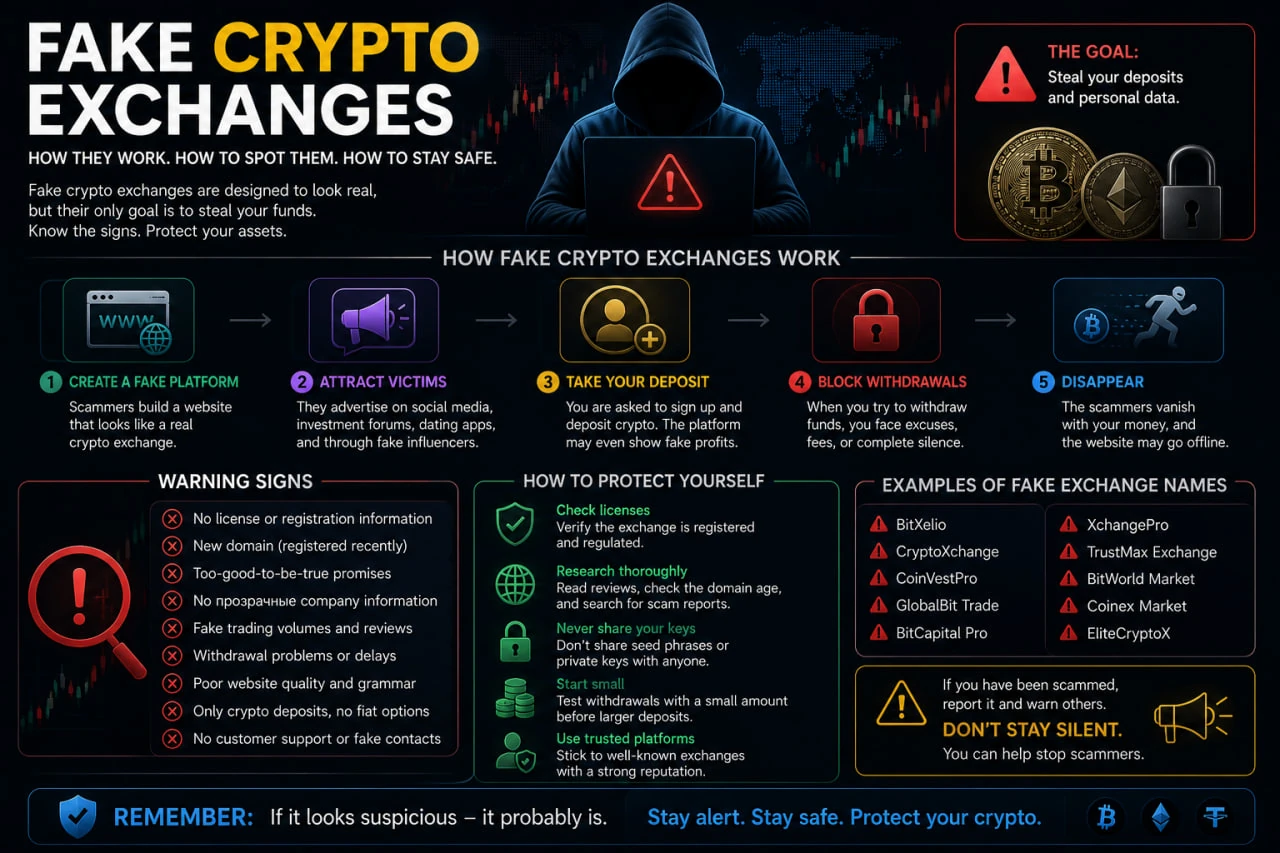
The cryptocurrency industry has evolved into a global financial market worth trillions of dollars. Millions of users buy, sell, and store digital assets through crypto exchanges every day.
Unfortunately, scammers have evolved alongside the industry.
While earlier crypto fraud schemes focused on Ponzi structures and fake investment programs, one of the fastest-growing threats in 2026 is the rise of fake crypto exchanges.
Modern scam exchanges often look better than legitimate platforms. They feature:
- professional website design;
- mobile applications;
- trading terminals;
- 24/7 customer support;
- AI-powered tools;
- market analytics;
- and even fake regulatory claims.
The problem is simple:
Their goal is not to facilitate cryptocurrency trading.
Their goal is to collect deposits and prevent withdrawals.
By the time users realize they are dealing with a fraudulent platform, their funds are often already beyond recovery.
Quick 30-Second Crypto Exchange Safety Check
Before opening an account, ask yourself these five questions.
If two or more answers are “yes,” proceed with extreme caution.
☑ Was the exchange launched recently?
☑ Is its license impossible to verify?
☑ Does it promise guaranteed profits?
☑ Does it require extra payments to withdraw funds?
☑ Are representatives contacting you through Telegram or WhatsApp?
If multiple warning signs are present, additional verification is essential before depositing funds.
What Is a Fake Crypto Exchange?
A fake crypto exchange is a website or application that imitates a legitimate trading platform while providing little or no real access to cryptocurrency markets.
Users see:
- trading charts;
- account balances;
- transaction histories;
- profitable positions;
- portfolio growth;
- investment dashboards.
Behind the scenes, however, there may be:
- no real liquidity;
- no genuine trading activity;
- no regulatory oversight;
- no verifiable legal entity.
In some cases, every number displayed inside the platform is generated internally.
As long as users continue depositing money, everything appears normal.
The problems usually begin when they attempt to withdraw funds.
Legitimate Crypto Exchange vs Fake Crypto Exchange

| Feature | Legitimate Exchange | Fake Exchange |
|---|---|---|
| Regulation | Verifiable | Missing or unverifiable |
| Legal Entity | Publicly identifiable | Hidden or nonexistent |
| Domain Age | Usually years old | Often weeks or months old |
| Withdrawals | Function normally | Frequently blocked |
| Customer Support | Resolves issues | Requests additional payments |
| Profit Claims | No guarantees | Often promises returns |
| Regulatory Warnings | Typically absent | Frequently appears on warning lists |
Why Fake Crypto Exchanges Are Increasing
AI Has Reduced the Cost of Fraud
Several years ago, scammers needed:
- developers;
- designers;
- copywriters;
- marketers.
Today, AI can automate much of that work.
Fraudsters use AI to:
- generate fake reviews;
- create financial articles;
- produce legal documents;
- automate customer support;
- generate deepfake videos;
- build fake rankings and comparison sites.
As a result, many scam exchanges now look more professional than legitimate startups.
Crypto Users Are Used to New Brands
The crypto market constantly introduces:
- new exchanges;
- new tokens;
- new wallets;
- new DeFi protocols.
Scammers exploit this environment.
Users are accustomed to seeing unfamiliar platforms, making it easier for fraudulent exchanges to blend in.
The Scale of the Problem
Fake crypto exchanges are far more common than many investors realize.
According to:
cryptocurrency investment fraud generated more than $7.2 billion in reported losses in the United States alone.
Research from:
Chainalysis Crypto Crime Report
shows that crypto-related fraud generates tens of billions of dollars globally each year.
Fake exchanges remain one of the primary tools used in these schemes.
7 Major Warning Signs of a Fake Crypto Exchange
No Verifiable License
If an exchange claims to be regulated, it should be possible to verify that claim.
Useful resources include:
If regulation cannot be confirmed, caution is warranted.
Recently Registered Domain
Many scam exchanges claim:
“Operating since 2018.”
Yet WHOIS records often reveal that the website was registered only months ago.
You can verify domain information through:
Withdrawal Deposits
Legitimate exchanges deduct fees directly from account balances.
Fraudulent exchanges often demand:
- AML Fees;
- Security Deposits;
- Verification Fees;
- Tax Payments.
This is one of the strongest scam indicators.
Guaranteed Returns
Claims such as:
- “Risk-free AI trading”
- “Guaranteed profits”
- “Fixed daily returns”
should always trigger skepticism.
Legitimate exchanges do not guarantee investment performance.
Telegram and WhatsApp Pressure
Many fake exchanges rely heavily on direct messaging and aggressive sales tactics.
Professional financial institutions rarely operate this way.
Hidden Ownership
A legitimate exchange should provide:
- company details;
- registration information;
- verifiable addresses.
Scam platforms frequently hide this information.
Withdrawal Complaints
Repeated reports of blocked withdrawals are among the strongest warning signs available.
The Mathematics of Fraud
Suppose a platform promises:
2% profit every day.
That translates to approximately:
- 60% per month;
- 730% per year.
At 3% daily returns, the numbers become even more unrealistic.
No regulated financial institution can sustainably generate such returns without extreme risk.
This is why guaranteed-profit marketing remains one of the clearest fraud indicators.
How Fake Crypto Exchange Scams Work
Stage 1: Victim Acquisition
Scammers typically use:
- Telegram;
- WhatsApp;
- Instagram;
- TikTok;
- Facebook;
- dating platforms.
Pig Butchering schemes are especially common.
Stage 2: Displaying Profits
Users see:
- growing balances;
- successful trades;
- profitable positions;
- analyst recommendations.
The displayed performance may have no connection to real market activity.
Stage 3: Increasing Deposits
After initial success, victims are encouraged to invest larger amounts.
This is where most losses occur.
Stage 4: Blocking Withdrawals
Once withdrawal requests are submitted, new obstacles appear:
- taxes;
- compliance checks;
- AML reviews;
- verification payments.
The withdrawal never arrives.
Why Scam Exchanges Demand Additional Payments
Most victims realize something is wrong only when they try to withdraw funds.
Until then, everything appears to function normally.
AML Fee Scam
Users are told:
“Your account is undergoing AML verification.”
To complete the process, they must pay:
- AML Fees;
- Compliance Fees;
- Security Fees.
Legitimate AML procedures do not require separate deposits to unlock funds.
Tax Before Withdrawal Scam
Another common message is:
“You must pay taxes before withdrawal.”
After payment:
- another fee appears;
- additional verification is required;
- new payments are requested.
Withdrawals remain blocked.
Verification Deposit Scam
Users are told:
“Please deposit additional funds to verify your identity.”
New payment requests continue after the deposit is made.
This is one of the most common fake exchange tactics.
Real Platforms That Raised Regulatory Concerns
TitanLedger
TitanLedger appeared in investor warnings issued by CySEC concerning unauthorized investment services.
Current warnings can be reviewed through:
Miralim
Miralim became the subject of a warning published by Germany’s financial regulator regarding financial services provided without the necessary authorization.
Official notices are available at:
Investomania
Independent investigations raised questions regarding transparency, corporate structure and regulatory claims associated with Investomania.
Grow Gain Limited
The project relied heavily on investment marketing and profitability claims while facing criticism regarding transparency and operational credibility.
Check the Exchange Through CoinMarketCap and CoinGecko
If a platform claims:
- millions of users;
- global operations;
- significant trading volume;
verify its presence on:
Absence alone does not prove fraud.
However, major claims combined with a complete lack of industry presence deserve further scrutiny.
AI and the New Generation of Fake Exchanges
Artificial intelligence has become one of the most important tools used by modern scammers.
AI enables:
- fake reviews;
- deepfake videos;
- synthetic analysts;
- automated customer support;
- fake rankings;
- investment news generation.
As a result, scam exchanges often appear highly professional.
The biggest mistake investors make is assuming that good design equals legitimacy.
How Scammers Manufacture Reputation
A large number of positive reviews no longer guarantees credibility.
Modern fraud networks use:
- AI-generated reviews;
- purchased accounts;
- fake rating systems;
- automated content farms;
- review manipulation campaigns.
Additional review checks can be performed through:
Pay attention not only to ratings but also to complaint patterns involving:
- blocked withdrawals;
- unexpected fees;
- AML Fee requests;
- verification deposits;
- customer support issues.
Fake Crypto Exchange Apps
Another major threat in 2026 involves fake mobile applications.
Scammers frequently imitate:
Fake apps may:
- steal seed phrases;
- collect wallet credentials;
- redirect deposits;
- compromise devices.
Users should only download applications from official sources.
How to Verify a Crypto Exchange in Five Minutes
Step 1: Verify Regulation
Check FCA, CySEC and FinCEN databases.
Step 2: Check Warning Lists
Step 3: Check Historical Records
Step 4: Verify Industry Presence
Use CoinMarketCap and CoinGecko.
Step 5: Review Independent Investigations
Do not rely solely on customer reviews.
Additional Red Flags
Risk becomes particularly high when a platform simultaneously:
- guarantees profits;
- promotes AI trading;
- promises passive income;
- requires withdrawal deposits;
- operates through Telegram;
- hides ownership;
- uses a newly registered domain.
This combination appears frequently in crypto fraud investigations.
FAQ
Can a new crypto exchange be legitimate?
Yes.
However, regulation, ownership, domain history and reputation should be verified before depositing funds.
Can an exchange charge withdrawal fees?
Network fees are normal.
Separate deposits required to unlock withdrawals are not.
What should I do if an exchange refuses withdrawals?
Do not send additional money.
Preserve:
- communications;
- wallet addresses;
- transaction records;
- account screenshots.
What is the strongest sign of a fake exchange?
Repeated requests for new payments while existing funds remain inaccessible.
Can online reviews be trusted?
Not always.
Many reviews in 2026 may be AI-generated or distributed through paid networks.
Conclusion
Fake crypto exchanges have become one of the most dangerous forms of cryptocurrency fraud.
Modern scammers leverage:
- AI;
- deepfake technology;
- synthetic reviews;
- professional fintech design;
- fake mobile applications;
- psychological manipulation;
- international laundering infrastructure.
Before depositing funds, investors should verify not the appearance of a platform but its regulation, domain history, warning-list status, legal transparency and withdrawal track record.
Five minutes of due diligence can prevent the loss of thousands of dollars and help avoid one of the most common crypto fraud schemes of the modern market.
Lost money with a broker? Find out how to get it back! Contact us at [email protected], leave your name and phone number so we can get back to you. The Watchdog Online team stands guard over your safety — together we will make the Internet better!