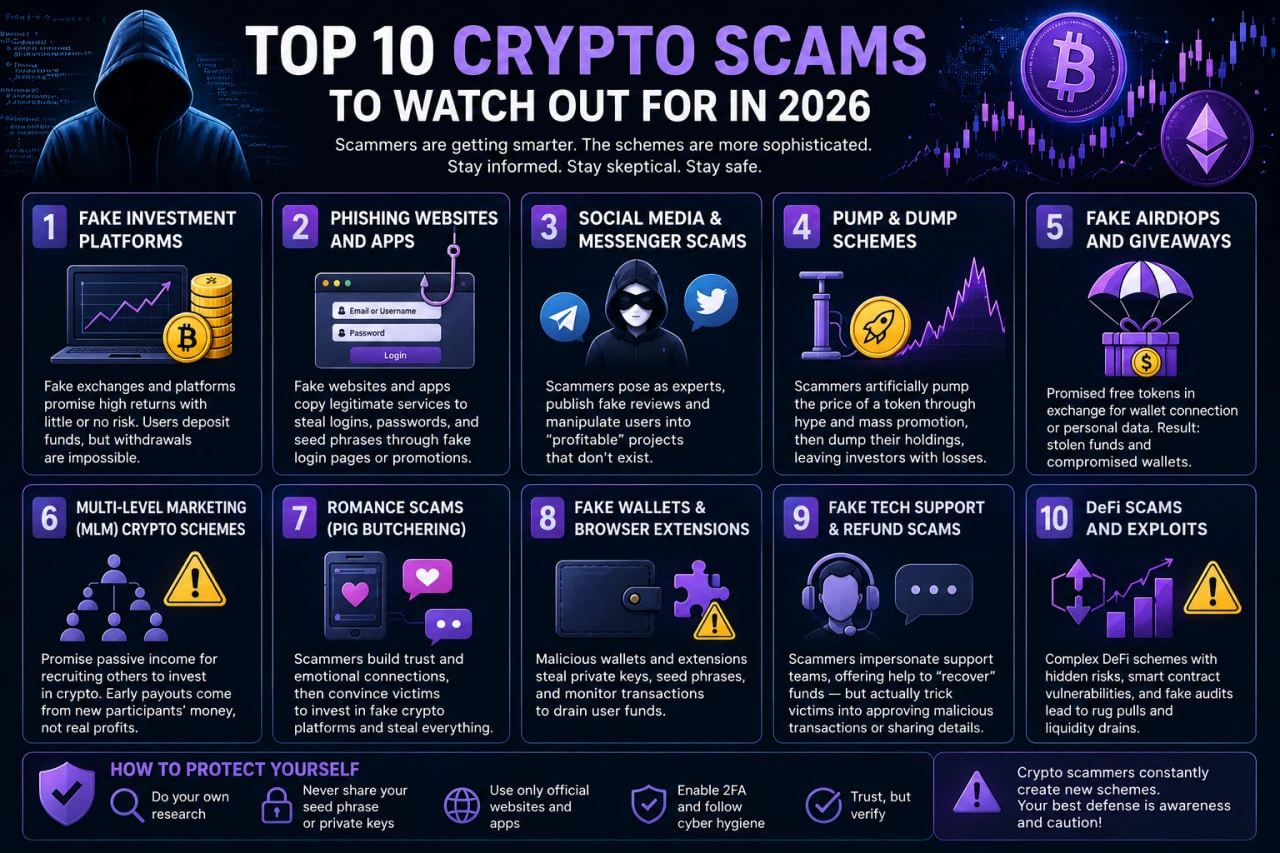
Crypto fraud in 2026 no longer resembles the amateur “Telegram scams” of previous years.
Today’s crypto scam ecosystem combines:
- AI-generated content;
- deepfake videos;
- industrial-scale phishing;
- professional laundering networks;
- wallet-drainer infrastructure;
- and fake investment platforms visually indistinguishable from legitimate fintech companies.
According to Chainalysis, crypto scams and fraud exceeded $14 billion in 2025 and may surpass $17 billion after final attribution analysis.
At the same time, the FBI IC3 Report documented more than $7.2 billion in cryptocurrency investment-fraud losses in the United States alone.
The defining characteristic of crypto fraud in 2026 is industrialization.
Scammers no longer operate manually. They now use scalable systems powered by AI, synthetic media and international money-laundering infrastructure.

1. Pig Butchering crypto scam – the most dangerous scheme of 2026
How the scheme works
Victims receive:
- random text messages;
- dating-app introductions;
- “wrong number” conversations;
- Telegram or WhatsApp investment chats.
The scam then escalates through:
- emotional trust-building;
- fake trading dashboards;
- small “test” profits;
- larger investment requests;
- blocked withdrawals;
- fake taxes and verification fees.
Why the scheme became so dangerous
Pig Butchering remains the highest-loss crypto fraud category globally.
The model combines:
- stablecoin transfers;
- AI-powered communication;
- fake investment platforms;
- deepfake support agents;
- and professional laundering infrastructure.
Major red flags
- newly registered domains;
- AI trading marketing;
- “institutional trading” claims;
- WhatsApp investment groups;
- round-number returns;
- pressure to increase deposits.
Common platform examples
Anti-scam investigations frequently reference:
- Climax Trading;
- Climax Markets;
- Climax Prime;
- Investomania;
- fake AI trading platforms;
- pseudo-quant trading websites.
How to verify regulation
UK:
FCA Register
EU:
CySEC
Russia:
Central Bank Warning List
2. Wallet Drainer scam – how crypto is stolen through malicious approvals

What is a wallet drainer?
A wallet drainer is a phishing mechanism where users:
- connect their wallets;
- sign malicious approvals;
- confirm permit signatures;
- or interact with fake NFT or airdrop websites.
Scammers then gain permission to directly transfer tokens from the wallet.
Why the scheme exploded
The rise of:
- drainer kits;
- phishing-as-a-service;
- Telegram drainer markets;
- and exploit bundles
made large-scale phishing accessible even to inexperienced criminals.
Main warning signs
- fake airdrops;
- NFT mint scams;
- unlimited token approvals;
- Discord/X account hijacks;
- fake staking dashboards;
- urgent revoke prompts.
Known examples
Widely discussed drainer infrastructures include:
- Monkey Drainer;
- Angel Drainer;
- Pink Drainer;
- fake Ledger phishing campaigns.
Protection tools
Useful approval-management tools:
3. Recovery scam – “we can recover your crypto”
How the scam works
After losing crypto funds, victims are contacted by:
- “law firms”;
- “FBI investigators”;
- “blockchain recovery specialists.”
The scammers then demand:
- advance payments;
- taxes;
- service fees;
- or wallet access.
Why recovery scams are growing
Scammers actively purchase databases of:
- rug-pull victims;
- fake-broker clients;
- wallet-drainer victims.
This means victims are targeted a second time.
Major red flags

- guaranteed fund recovery;
- fake recovery agencies;
- IC3 impersonation;
- requests for upfront USDT payments.
Official reporting
Real FBI reporting portal:
FBI IC3
4. Task scams and fake crypto jobs
How the scheme works
Victims are offered:
- remote online jobs;
- app optimization work;
- Telegram earning systems;
- simple “microtasks.”
Initially:
- small payouts create trust.
Later:
- deposits are required;
- “balance unlock” payments appear;
- victims are pressured to top up repeatedly.
Why the scheme became massive
The FTC documented explosive growth in:
- Telegram task scams;
- fake crypto jobs;
- app optimization fraud.
Common platforms used
Most frequently:
- Telegram;
- WhatsApp;
- TikTok;
- fake HR websites.
5. Address poisoning crypto scam
What happens
The scammer:
- creates a wallet visually similar to a legitimate address;
- sends a zero-value transaction;
- places the address in the victim’s history;
- waits for the victim to copy it by mistake.
Why it is dangerous
Even experienced users have lost millions.
Chainalysis analyzed a nearly $68 million WBTC incident involving a poisoned address.
Protection advice
Never:
- copy wallet addresses from transaction history;
- verify only the first and last characters.
6. Bitcoin ATM scams and QR-code fraud

How the scheme works
Victims receive calls from:
- “banks”;
- “police”;
- “tax authorities”;
- “technical support.”
They are instructed to:
- withdraw cash;
- visit a Bitcoin ATM;
- scan a QR code;
- send crypto immediately.
Most vulnerable targets
The most common victims are:
- elderly users;
- inexperienced crypto holders;
- people under emotional pressure.
Biggest red flag
Any urgent demand to:
“send crypto through a Bitcoin ATM.”
7. Deepfake crypto scam – AI fraud enters the mainstream
What AI changed
Artificial intelligence now enables scammers to:
- clone voices;
- generate deepfake livestreams;
- impersonate celebrities;
- create fake investment analysts.
Most common deepfake targets
Frequently impersonated:
- Elon Musk;
- Nvidia executives;
- crypto influencers;
- AI trading personalities.
How the scam appears
Typical examples:
- “Send 1 ETH – receive 2 ETH”;
- fake AI trading launches;
- fake crypto giveaways;
- synthetic livestream promotions.
Why this trend matters
Chainalysis reports explosive growth in:
- AI-enabled scams;
- synthetic impersonation;
- deepfake financial fraud.
8. Rug Pull and memecoin scams
How rug pulls work
Token creators:
- generate hype;
- buy influencer promotion;
- manipulate volume;
- concentrate liquidity.
Then:
- dump tokens;
- remove liquidity;
- collapse the price.
Main warning signs
- anonymous teams;
- unlocked liquidity;
- fake partnerships;
- wash trading;
- coordinated influencer campaigns.
Known cases
Major investigations referenced:
- Kokomo Finance;
- the $LIBRA collapse;
- multiple Solana memecoin scams.
Useful token-analysis tools
9. Crypto Ponzi and HYIP schemes
Core mechanism
Projects promise:
- guaranteed returns;
- AI arbitrage;
- cloud mining;
- “risk-free AI trading”;
- fixed ROI.
In reality, payouts come from new deposits.
Main warning signs

- guaranteed profitability;
- aggressive referral systems;
- MLM structures;
- fake incorporation documents;
- unverifiable trading activity.
Large-known cases
Widely discussed:
- HyperFund;
- NovaTech;
- HashFlare.
Biggest red flag
If a project:
- guarantees returns;
- heavily pushes referrals;
- hides its real trading model —
the risk level is extremely high.
10. Fake donation scams and fraudulent fundraising
How the scheme works
Scammers exploit:
- wars;
- disasters;
- humanitarian crises;
- animal rescue fundraising;
- political campaigns.
They create:
- fake donation wallets;
- cloned charity websites;
- Telegram fundraising campaigns.
Why it works
During crises, people:
- verify less;
- react emotionally;
- transfer funds faster.
Why crypto fraud in 2026 became so dangerous
The defining feature of modern crypto fraud is:
- scalability;
- automation;
- AI integration;
- industrial phishing;
- international laundering networks.
Modern scam operations use:
- AI-generated websites;
- deepfake media;
- synthetic reviews;
- fake fintech UX;
- automated support systems;
- crypto laundering infrastructure.
That is why modern scams look significantly more convincing than older schemes.
How users can realistically protect themselves
Never:
- send crypto to “unlock withdrawals”;
- trust guaranteed returns;
- sign unknown approvals;
- copy wallet addresses from history;
- trust livestream giveaways.
Always:
- verify regulation;
- check WHOIS data;
- search warning lists;
- verify liquidity locks;
- use revoke tools;
- verify wallet addresses completely.
Useful official resources
Chainalysis Crypto Crime Reports
FAQ
What is Pig Butchering?
A long-term investment scam where victims are emotionally manipulated before funds are stolen through fake crypto trading platforms.
What is a wallet drainer?
A phishing mechanism that steals crypto assets through malicious approve or permit signatures.
Can stolen crypto be recovered?
Sometimes — but only if exchanges and law enforcement are contacted quickly.
Most crypto transfers remain irreversible.
Why are AI scams growing so fast?
Because AI:
- lowers fraud costs;
- automates scam infrastructure;
- enables deepfake media;
- and scales social engineering globally.
Conclusion

Crypto fraud in 2026 is no longer just “Telegram scams.”
It is now a full-scale underground industry powered by:
- AI;
- deepfake technology;
- phishing-as-a-service;
- laundering networks;
- synthetic fintech infrastructure;
- and industrial psychological manipulation.
And the more professional a crypto project looks, the more important it becomes to verify:
- regulation;
- jurisdiction;
- domain history;
- warning lists;
- and the real origin of its profits.
Read also: https://watchdog-online.com/reviews/equifaxintrestllc-com-scam-review-regulatory-warning-analysis/
https://watchdog-online.com/article/primetechcaptltd-com-razvod-ili-net-otzyvy-2026/