Introduction
One of the most effective tactics in modern financial scams is borrowing credibility from real regulators.
Instead of staying anonymous, many high-risk projects present themselves as licensed investment funds, often referencing trusted jurisdictions like Switzerland to appear more legitimate.
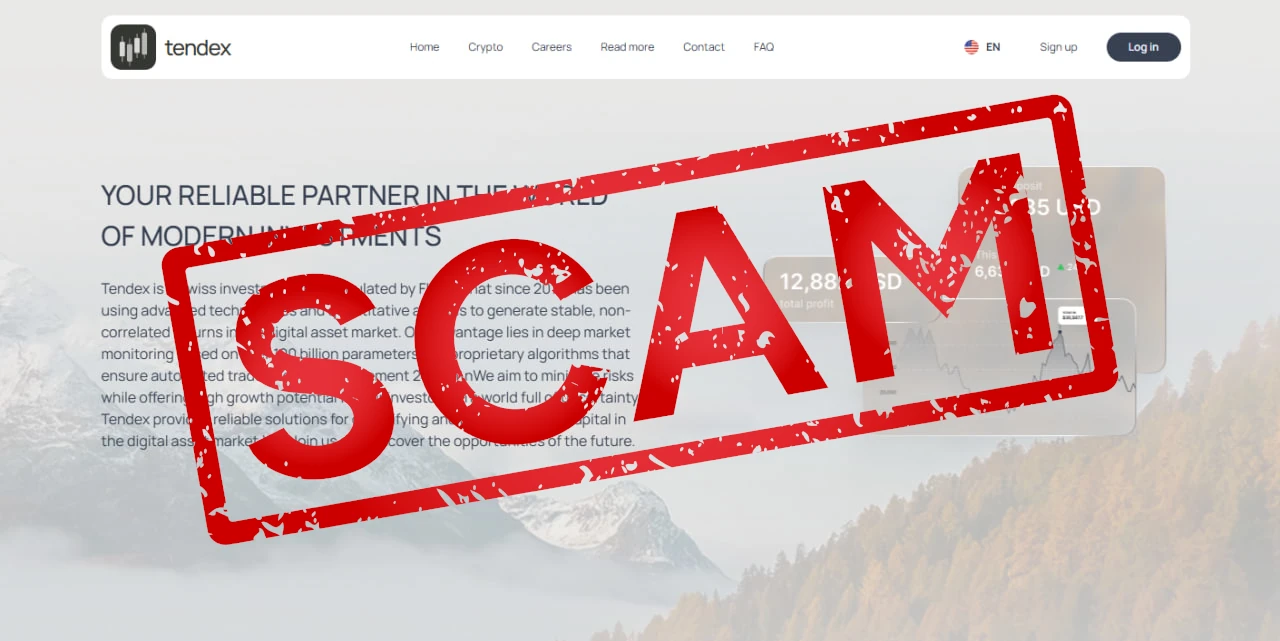
Tendex.capital follows this exact approach. The platform positions itself as a Swiss investment fund, claiming regulatory oversight and a long operational history.
But the real question isn’t what the website says—it’s whether those claims can be verified in official financial registers.
Users searching for:
— “tendex.capital review”
— “tendex scam”
— “is Tendex Capital FINMA regulated”
are doing the right thing. Verifying before investing is critical, because most losses happen when users rely on narratives instead of evidence.
Our analysts conducted a full investigation into Tendex.capital, reviewing domain records, regulatory claims, operational structure, and external indicators.
The findings point to a high-risk structure, consistent with fake investment fund models, where legitimacy is presented but not confirmed.
The key takeaway is straightforward:
if a platform claims regulation but cannot prove it through official sources, that claim is not protection—it’s part of the illusion of credibility.

Tendex.capital general information
| Parameter | Details |
|---|---|
| Domain | tendex.capital |
| Registration date | January 2026 |
| Claimed activity | Investment fund |
| Claimed regulation | FINMA (Switzerland) |
| Actual model | Investment scheme / pseudo fund |
| License status | Not confirmed |
Tendex.capital regulatory claims – FINMA verification
The website states that Tendex Capital is regulated by FINMA, the Swiss Financial Market Supervisory Authority.
Official FINMA register:
https://www.finma.ch/en/authorisation/
FINMA is responsible for supervising:
- banks
- asset managers
- investment funds
- financial intermediaries
Any regulated entity must be verifiable through official records.
However, verification does not confirm the presence of Tendex Capital in the FINMA register.
The review of official regulatory registers does not confirm the existence of any license.
Tendex.capital verification across international regulators
Additional checks were conducted through:
FCA (UK):
https://register.fca.org.uk/
CySEC (EU):
https://www.cysec.gov.cy/
BaFin (Germany):
https://www.bafin.de/EN/Homepage/homepage_node.html
No authorised entity linked to Tendex.capital was identified.
This indicates the absence of regulatory oversight in any major financial jurisdiction.
Tendex.capital WHOIS and domain lifecycle analysis
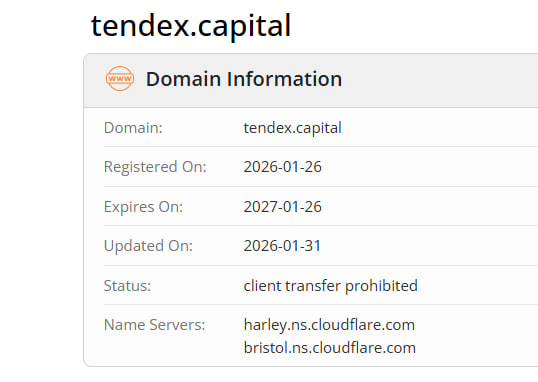
Domain data reveals:
- registration in January 2026
- short-term lifecycle
- no confirmed operational history
This is inconsistent with the claim of a fund operating since 2019.
Legitimate investment funds:
- maintain long-established domains
- provide historical transparency
- operate under consistent branding
Tendex.capital narrative inconsistency – timeline conflict
A key contradiction in the project:
- claimed founding year: 2019
- actual domain registration: 2026
This creates a direct inconsistency between:
- marketing narrative
- technical reality
Such discrepancies are a strong indicator of fabricated corporate history.
Tendex.capital reputation manipulation – SERM pattern
Search results for Tendex Capital show:
- articles claiming legal verification
- references to FINMA compliance
- “expert reviews” confirming legitimacy
These publications often appear on content platforms and are formatted as professional legal assessments.
This pattern aligns with SERM (Search Engine Reputation Management), where:
- positive content is artificially promoted
- critical reviews are suppressed
- user perception is controlled
Legitimate funds rely on regulatory transparency, not reputation engineering.
Tendex.capital operational model – investment scheme structure

The platform offers tiered investment levels:
- entry-level deposits
- premium tiers
- VIP access
This structure is commonly used to:
- increase user commitment
- escalate deposits
- create psychological pressure
It does not reflect standard investment fund operations.
Tendex.capital withdrawal issues – financial coercion indicators
User reports and external sources indicate:
- blocked withdrawals
- additional payment requests
- account restrictions
Common explanations include:
- “tax obligations”
- “processing fees”
- “compliance charges”
Legitimate financial institutions do not require external payments to release client funds.
Tendex.capital reviews and external signals
Sources:
- https://www.youtube.com/watch?v=mcDqGCgXkNU
- https://telltrue.net/eto-lohotron/tendex/
- https://torforex.ru/rejting-trejderov/tendex-capital-otzyvy/
Reported issues include:
- inability to withdraw funds
- pressure from account managers
- misleading investment conditions
Tendex.capital vs legitimate investment funds
Legitimate funds:
- operate under verified regulation
- provide transparent documentation
- maintain consistent operational history
Tendex.capital:
- lacks verifiable licensing
- presents inconsistent history
- relies on reputation manipulation
Tendex.capital scam or legit assessment
Based on all available data:
- regulatory claims are not confirmed
- domain age contradicts operational history
- user complaints indicate withdrawal issues
Tendex.capital does not demonstrate characteristics of a legitimate investment fund.
Tendex.capital investor warning
If a platform:
- claims regulation without verification
- shows inconsistent timeline data
- requires deposits with unclear safeguards
- presents withdrawal barriers
it represents a high-risk investment environment.
Conclusion

Tendex.capital presents itself as a FINMA-regulated investment fund, but it does not provide verifiable proof to support this claim.
A closer look reveals several warning signs: unconfirmed regulation, inconsistencies in the platform’s narrative, and concerns related to withdrawals.
In regulated environments, licensing and oversight can always be checked through official registers. When this verification is not possible, the claim itself becomes unreliable.
Because of this, the platform aligns more closely with high-risk financial schemes than with legitimate investment services.
Our experts therefore recommend avoiding any financial interaction with this project until clear and independently verifiable information is available.
The key takeaway is simple:
if regulatory claims cannot be verified through official sources, they should be treated as invalid.
Lost money with a broker? Find out how to get it back! Contact us at [email protected], leave your name and phone number so we can get back to you. The Watchdog Online team stands guard over your safety — together we will make the Internet better!
Read also: https://watchdog-online.com/reviews/sanatiseit-com-scam-review-regulatory-warning/